
About This Course
History is an inspirational, dynamic, relevant subject. The breadth of topics offered in our degree span the Neolithic period right up to the more recent past. Covering aspects of the history of Wales, Britain, Europe and the wider world, you will build knowledge in political, social and cultural themes. Valued by employers, the practical and transferable skills gained will prepare you for many possible careers, e.g. civil service, heritage sector, the media, or law.
This course aims to develop your knowledge and understanding of a wide range of human history. It encourages you to take an analytical approach to the past, so that you can understand and contribute to historical controversies, and can understand ways in which the past is at least partly constructed in the present. It therefore hopes to train you intellectually so you can explain the relevance of the past in the present, understand the problems of interpreting written and other evidence, and gain skills of research, analysis, problem-solving, construction of argument and communication.
History is one of the most inspiring, dynamic and relevant subjects that can be studied at degree level, and so it is no surprise that History remains one of the most popular degree subjects in the UK. It has an established range of concerns, but it is always expanding and changing as it responds to new themes or ideas raised by other disciplines. It is also a very practical subject, and during your degree you will develop various transferable skills that employers value highly. Surveys consistently indicate that History graduates obtain employment more rapidly than graduates in many apparently more 'vocational' subjects.
Why choose Bangor University for this course?
- A flexible degree structure that encourages you to explore and develop your interests.
- 100% Student satisfaction, History BA (NSS 2020).
- A local area steeped in history (including UNESCO World Heritage Sites) and provides a resource for fieldwork and a superb location for study.
- We have experts in all fields of history from the Middle Ages to the 20th century, working principally on Britain, Europe and the USA.
EXPLORE MORE IN HISTORY, ARCHAEOLOGY AND HERITAGE
History, Archaeology and Heritage are complementary subjects – which together provide a richer understanding of past peoples and societies. At Bangor we offer a range of courses that allow you to study one or more of these.
Course Content
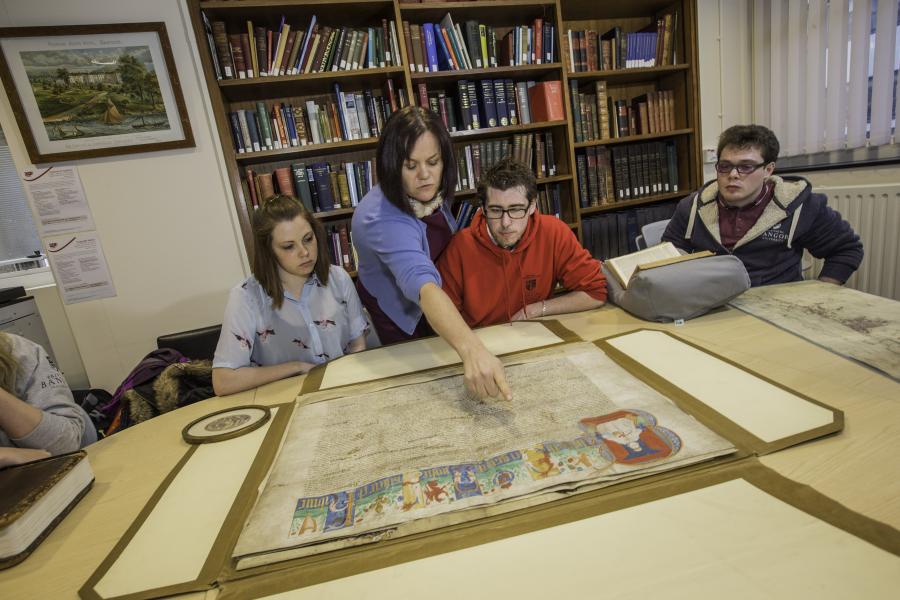
During your degree you will learn through a variety of small-group seminar classes, fieldtrips, practical workshops, one-to-one tuition, and lectures of between 10 and 50 students. With key historic and World heritage sites on the doorstep, our location gives access to a rich resource of local heritage sites, monuments, and museums. From prehistorical burial mounds to stately homes and castles, this tremendous resource is an integral part of the course and used in our teaching through field trips, practical workshops, and excavations.
In the first year of your History degree you will choose from a selection of modules that are intended to provide a flavour of the degree as a whole. In the second and third year you will have a wide choice of more specialist and thematic modules with close consideration of original sources. This allows you to tailor your degree to your own interests. You will also research and write a dissertation on a topic of your choice in Year 3.
Alongside classroom teaching and fieldtrips, you will also benefit from a range of other academic and social activities in the School. These include student conferences and School journal, quizzes and social occasions, student-led trips and talks. Our students are also able to benefit from University schemes such as ‘Languages for All’ and ‘Welsh for Adults’ (free languages classes in French, German, Italian, Mandarin Chinese, Spanish and Welsh) and the Study Skill Centre.
Outside this time, you will prepare for seminars, carry out research, and complete assignments. Assessment is a mixture of essays, projects, presentations, and examinations. The dissertation is an important part of the final assessment. Throughout the course you will be supported by our expert and enthusiastic teaching staff.
Facilities
General University Facilities
Library and Archive Services
Our four libraries provide a range of attractive study environments including collaborative work areas, meeting rooms and silent study spaces.
We have an extensive collection of books and journals and many of the journals are available online in full-text format.
We house one of the largest university-based archives not only in Wales, but also the UK. Allied to the Archives is the Special Collections of rare printed books.
Learning Resources
There is a range of learning resources available, supported by experienced staff, to help you in your studies.
The University’s IT Services provides computing, media and reprographics facilities and services including:
- Over 1,150 computers for students, with some PC rooms open 24 hours a day
- Blackboard, a commercial Virtual Learning Environment, that makes learning materials available on-line.
Careers
History is a very versatile degree. This course provides specialist knowledge and a range of analytical and presentational skills which will enable you to tackle a variety of career options centring on administrative and leadership needs, for example, in company personnel departments, the civil service and local government as well as in a range of directly transferable vocations. Our History graduates enter a wide range of employment: especially fields which require skills of communication, analysing large quantities of information, and understanding human nature. Graduates have in recent years gained careers in museum work, law, teaching and the cultural industries. Many graduates also progress to higher education postgraduate schemes.
History graduates are desirable employees due to the variety of skills they develop during their degree. These transferable skills include:
- An ability to review critically the literature and formulate logical and structured arguments
- An ability to make effective oral presentations
- The development of writing and editorial skills
- An appreciation of the complexity and diversity of situations, events and past mentalities
- Experience gained from carrying out and completing a major research project in the third year – the dissertation
- Good IT skills
- Time management skills
These transferable skills are fundamental to other employment sectors, such as the public sector, teaching, journalism, law, accountancy and management.
Year 2 and 3 students are provided with the opportunity to complete work-placement modules, which can be carried out in the university or through external organizations. These are assessed as part of the final degree. The programme enhances employability prospects and offers an insight into the type of employment opportunities a degree in history offers. Students have undertaken placements in a wide range of workplaces, including archives and heritage agencies.
International Experience Year
This course is available with an International Experience Year option where you will study for 1 additional year.
Studying abroad is a great opportunity to study with specialists, see a different way of life and broaden your horizons. With international experience of this kind, you’ll really improve your career prospects. If you plan to study in a country where English is not spoken natively, there may be additional language support available for you.
There are a wide variety of destinations to choose from and when you graduate you will have ‘with International Experience’ added to your degree title.
You can find out more about the International Experience Year programme on the Student Exchanges section of our website.
You will have the opportunity to fully consider this option when you have started your course at Bangor and can make an application for a transfer onto this pathway at the appropriate time. If you have any questions in the meantime, please get in touch.


My name is Kavisha Prince Anthony, and I always had a dream of studying abroad. Thankfully, that dream came to life since I applied to the Study Advisor. I was able to receive my visa within four days. I also had some visa refusals in the past; I had about six UK visa refusals in the past, but thankfully, it was not an issue since the Study Advisor was able to make things work this time. I highly recommend Study Advisor for your dreams of going abroad, whether it be the UK or any other European country there is.