
About This Course
Studying Music is a creative opportunity to grow as a musician, guided by world-renowned composers, performers, musicologists and researchers. We have a long tradition of academic excellence and our courses are unique for the variety of options available. We aiming to ensure that our graduates have the capacity to become national and international leaders in their fields. Our practice-based Music teaching presents unique opportunities for student compositions to be performed, for interactions between live music and electronics, and for historically-informed performance arising from our musicological activity. You will make and study music with other, like-minded young musicians, composers and musicologists, honing your craft and exploring the field. You also have the opportunity to choose modules in other subjects, broadening your educational experience and career prospects. In your final year, you will have the opportunity to follow a specialism of your own, stretching your abilities and proving yourself.
You will be part of a vibrant music community, performing in, or attending performances at, public venues such as Pontio or the magnificent Prichard Jones Hall. Your musical experience will extend beyond the lecture room, with opportunities to join the University Symphony Orchestra, Chamber Choir or one of the many student societies for Music, such as Opera, Concert Band, DJ, Musical Theatre, and String Orchestra. Studying music sharpens your memory, encourages teamwork, provides an outlet for your creativity and equips you with the professional music skills appropriate to a wide range of careers.
The BA Music course includes optional modules from other subjects, while the BMus course is exclusively music modules.
Why choose Bangor University for this course?
- 6th in the UK for Overall Student Satisfaction in Music, 1st in Wales (NSS 2020).
- A wide range of options, allowing you to shape your course to reflect your interests and strengths.
- Music Performance Scholarships are offered to the most promising instrumentalists and/or vocalists.
- A dynamic music-making community: choirs, orchestras, bands, student ensembles and more.
- Two dedicated Music buildings, two professional concert halls, soundproofed practice suite, four state-of the-art electroacoustic studios, Pontio Arts Centre.
Course Content
Your Music degree programme at Bangor is flexible: you will shape your degree course to reflect your interests and strengths. You will begin your study of music in a genuinely all-embracing way, engaging with musical theory and practice from modal polyphony to electroacoustic composition, via every genre in between. You will use this broad framework as a launch pad for developing your own expertise in one of several fields of musicology, performance or composition, including 20th-century music, musical editing, classical or popular music performance, music in health and well-being, and all styles of composition. You also have the option to pursue studies in other subjects as part of your degree, or to focus exclusively on music.
Teaching is primarily carried out in small groups, providing a stimulating and supportive learning environment. You will have around 12 hours of lectures, seminars and tutorials each week. Solo Performance (optional) is taught through an innovative combination of individual tuition, workshops and masterclasses. In addition, you will spend time on background reading, listening to music, completing essays and coursework and preparing for seminars as well as rehearsing and performing in ensembles, choirs and orchestras. Several modules may include field trips, for example to concerts, archives, recording studios and composition workshops. We have excellent links with leading organisations in the UK, including the BBC National Orchestra of Wales (with whom we have an annual composition workshop), the Royal Liverpool Philharmonic Orchestra, London Sinfonietta, Sain (Records) etc. Others involve short placements outside the University (for example, the Community Arts Placement module). You will also spend either one-third or two-thirds of your final year working on independent, supervised music projects.
Facilities
General University Facilities
Library and Archive Services
Our four libraries provide a range of attractive study environments including collaborative work areas, meeting rooms and silent study spaces.
We have an extensive collection of books and journals and many of the journals are available online in full-text format.
We house one of the largest university-based archives not only in Wales, but also the UK. Allied to the Archives is the Special Collections of rare printed books.
Learning Resources
There is a range of learning resources available, supported by experienced staff, to help you in your studies.
The University’s IT Services provides computing, media and reprographics facilities and services including:
- Over 1,150 computers for students, with some PC rooms open 24 hours a day
- Blackboard, a commercial Virtual Learning Environment, that makes learning materials available on-line.
Careers
A degree in Music offers you excellent employment prospects and the skills developed will allow you to excel in a wide range of music careers. As well as working as composers, performers, songwriters, editors, lyricists and conductors, many of our graduates take up posts with music publishers, orchestras, opera houses, or arts centres as music directors, creative coordinators, or administrators. Music graduates are always highly sought after in media and recording companies as technicians, producers, programme-planners, and writers. Other possible career paths include specialist music journalism, music publishing, music librarianship, and arts marketing. Several of our graduates have gone on to become distinguished academics, composers, and performers, many others are teachers, at all educational levels (up to and including university).
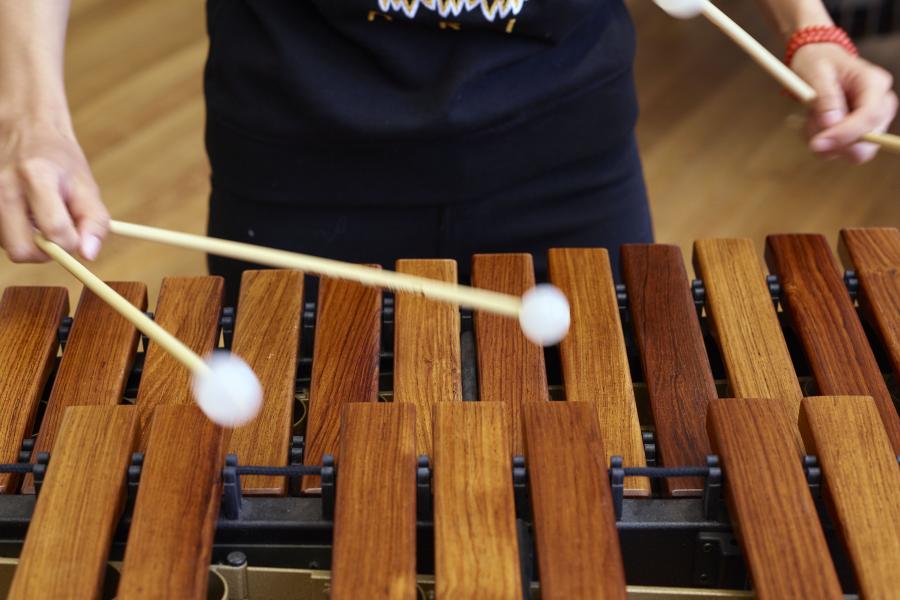
EXPLORE MORE IN MUSIC
If you have a passion for music, our BA Music and BMus Music will offer you the opportunity to engage with that passion and develop it into a professional career that you can follow for many years to come.
Additional Course Options
This course is available with a Placement Year option where you will study for 1 additional year. The Placement Year is undertaken at the end of the second year and students are away for the whole of the academic year.
The Placement Year provides you with a fantastic opportunity to broaden your horizons and develop valuable skills and contacts through working with a self-sourced organisation relevant to your degree subject. The minimum period in placement (at one or more locations) is seven calendar months; more usually you would spend 10-12 months with a placement provider. You would normally start sometime in the period June to September of your second year and finish between June and September the following year. Placements can be UK-based or overseas and you will work with staff to plan and finalise the placement arrangements.
You will be expected to find and arrange a suitable placement to complement your degree and will be fully supported throughout by a dedicated member of staff at your academic School and the University’s Skills and Employability Services.
You will have the opportunity to fully consider this option when you have started your course at Bangor and can make an application for a transfer onto this pathway at the appropriate time. If you have any questions in the meantime, please get in touch.


My name is Kavisha Prince Anthony, and I always had a dream of studying abroad. Thankfully, that dream came to life since I applied to the Study Advisor. I was able to receive my visa within four days. I also had some visa refusals in the past; I had about six UK visa refusals in the past, but thankfully, it was not an issue since the Study Advisor was able to make things work this time. I highly recommend Study Advisor for your dreams of going abroad, whether it be the UK or any other European country there is.