
About This Course
This course is a three-year honours degree, preparing you for a professional career in electronic systems design.
We’ve designed this course to accommodate anyone without the usual qualifications in mathematics and physics. Meaning you can pursue your interest in electronics and electronic systems to degree level. During the course you will get a thorough grounding in all the latest techniques in analogue and digital electronics, together with training in professional skills, project management techniques and an intensive preparation in maths and science for electronics. You will gain extensive practical experience to ensure that you develop sound practical skills as well as a thorough theoretical knowledge.
Why choose Bangor University for this course?
- There is high demand from international employers for graduates of this course.
- We have a 95% employability rating.
- We have a strong research base in optoelectronics, communications, microelectronics, bioelectronics and materials science, and organic and plastic electronics.
- Electronic Engineering at Bangor is ranked 4th in the UK for Research.
- This degree is accredited by the Institution of Engineering and Technology – you will gain exemption from the admission examinations enabling you to apply for membership and become a Chartered Engineer.
- It is also recognised by the European Federation of National Engineering Associations.
Course Content
You will spend about 12 hours in lectures and 8 in laboratories each week. You will also have tutorials and have to write up experiments, work on software design and complete numerical problem-solving exercises.
You will have an examination for each module at the end of the semester. Some modules have coursework assessment as well. Your laboratory work books, technical reports on some of the experiments and the final-year project also contribute to your marks.
The first year of the programme gives you the opportunity to build a solid foundation in designing, modelling and building analogue and digital circuits, additional support is provided for the mathematics 
The second year develops the foundations and applies these new skills to more advanced concepts in electronic circuits, including VLSI & Digital Circuits, Sustainable Project Management and Microelectronics and Nanophononics. 
During the third year of the course some optionality has been introduced to allow and individual specialism, complement this with the individual project you will have a unique and personalised experience.
Modules for the current academic year
Module listings are for guide purposes only and are subject to change. Find out what our students are currently studying on the Electronic Engineering Modules page.
Course content is for guidance purposes only and may be subject to change.
Facilities
- Large fully equipped computing laboratories and all the latest software.
- We have recently installed an immersive technologies laboratory, where the latest devices are used for project and research work. 
General University Facilities
Library and Archive Services
Our four libraries provide a range of attractive study environments including collaborative work areas, meeting rooms and silent study spaces.
We have an extensive collection of books and journals and many of the journals are available online in full-text format.
We house one of the largest university-based archives not only in Wales, but also the UK. Allied to the Archives is the Special Collections of rare printed books.
Learning Resources
There is a range of learning resources available, supported by experienced staff, to help you in your studies.
The University’s IT Services provides computing, media and reprographics facilities and services including:
- Over 1,150 computers for students, with some PC rooms open 24 hours a day
- Blackboard, a commercial Virtual Learning Environment, that makes learning materials available on-line.
EXPLORE MORE IN ELECTRONIC ENGINEERING
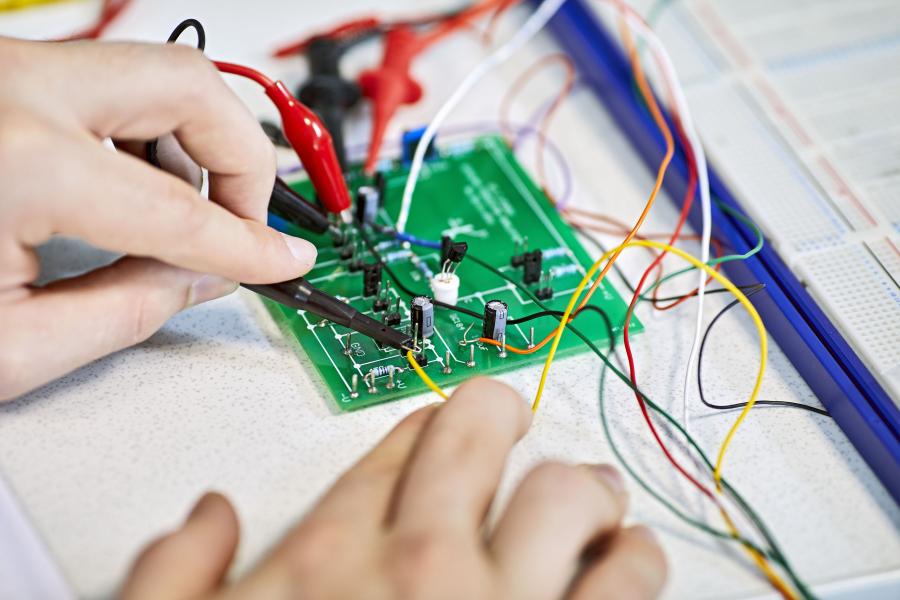
Electronic Engineering is the science that makes all digital advances possible. You will be taught by staff who are experienced electronic engineers and who maintain links with industry to ensure that courses reflect recent developments.
Careers
Graduates of this degree will have enviable career prospects: many will take up electronic or computer systems designer posts, or work for government or private research and development facilities.
Opportunities at Bangor
The University’s Skills and Employability Service provides a wide range of resources to help you achieve your graduate ambitions.
The Bangor Employability Award (BEA)
With the BEA, you can gain recognition for your extra-curricular activities (e.g. volunteering, clubs and societies, part-time work, etc.)
Internships
Bangor University runs a paid internship scheme within the university’s academic and service departments.
Student Volunteering
Volunteering widens your experience and improves your employability. Find out more about the volunteering on the Students’ Union’s website.
International Experience Year
This course is available with an International Experience Year option where you will study for 1 additional year.
Studying abroad is a great opportunity to study with specialists, see a different way of life and broaden your horizons. With international experience of this kind, you’ll really improve your career prospects. If you plan to study in a country where English is not spoken natively, there may be additional language support available for you.
There are a wide variety of destinations to choose from and when you graduate you will have ‘with International Experience’ added to your degree title.
You can find out more about the International Experience Year programme on the Student Exchanges section of our website.
You will have the opportunity to fully consider this option when you have started your course at Bangor and can make an application for a transfer onto this pathway at the appropriate time. If you have any questions in the meantime, please get in touch.


My name is Kavisha Prince Anthony, and I always had a dream of studying abroad. Thankfully, that dream came to life since I applied to the Study Advisor. I was able to receive my visa within four days. I also had some visa refusals in the past; I had about six UK visa refusals in the past, but thankfully, it was not an issue since the Study Advisor was able to make things work this time. I highly recommend Study Advisor for your dreams of going abroad, whether it be the UK or any other European country there is.