
About This Course
Learning disability (LD) nursing focuses on the value and rights of the person, effective communication, person-centred practice and using evidence-based practice to improve the health and well-being of people with a learning disability. LD nurses consider health in the widest possible sense and work in a range of careers with children or adults facing physical and mental health challenges or living with learning disabilities, helping clients to live their lives as fully and independently as possible.
Learning disability nursing is a unique and valued field of nursing. We work with people with a learning disability, who represent some of the most disadvantaged people in society. The role of the learning disability nurse, in partnership with the person, family, carers and other member of the multi-disciplinary team is to address health inequalities, so that the person can live as fully and independently as possible.
We define health in its broadest sense, we are concerned with social, psychological and physical health. Therefore, included in our course is a focus on the value of the person, the rights of the person. We empower people to overcome society’s barriers by using effective communication, person centred practice and evidence-based practice.
When studying to be a learning disability nurse you’ll spend half of your time at the university and the other half on placements. Whilst on placement you’ll work with people with a learning disability where you’ll be supported by learning disability nurses and other members of the multi-disciplinary team. Placements will give you an experience of working with children and adults and with some of our more specialised services. There will also be the opportunity to work in both community settings and residential settings.
As a learning disability nurse, you’ll achieve a qualification that will enable you to enter a fulfilling career working with children or adults who are living with a learning disability and who need the support of a learning disability nurse. Learning disability nurses can be seen working in different settings as well as for a range of different employers which include the NHS and independent sector. The unique skills of the learning disability nurse are increasingly deployed in other fields of nursing i.e. mental health and adult nursing environments.
The course is appropriate for careers working with people of all ages facing physical and mental health challenges or living with learning disabilities who need professional nursing care. Bangor accepts applications for nursing courses throughout the year, while places are still available. As some pathways do become full, we recommend applications are submitted as soon as possible.
Tuition Fees Covered
If you are considered a home UK student for tuition fees who can commit to working in Wales for two years after graduating, you could get your tuition fees covered in full through the NHS Wales Bursary Scheme and claim for a £1,000 bursary contribution towards living costs. You can also apply for the means tested bursary that is dependent on household income and other funding that has eligibility criteria for child care support, dependents allowance and parental learner allowance. You can also apply for the income based maintenance funding and a reduced rate loan from Student Finance. As this course is funded by NHS Wales, we are unable to accept applications from overseas students.
Full details are available on our NHS funding page.
Location
Some taught elements of this course are held at both the Bangor campus & Bangor University’s Wrexham campus next to Wrexham Maelor Hospital. You can choose which location you wish to apply for but some of the learning disability field content will be taught at Bangor.
Why choose Bangor for this course?
- Top 10 for Careers (Guardian Good University Guide 2021).
- Top 15 for Nursing and Midwifery (2nd in Wales) (Times Good University Guide 2021).
- Top 10 for Research Quality (Complete University Guide 2021).
- NHS funding currently available to cover fees and a contribution to living costs.
- Bangor and Wrexham campuses can offer flexibility in where you study, and clinical placements are available across north Wales.
Course Content
You’ll have compulsory theoretical study and clinical placements in hospitals, community and/or residential settings in north Wales. Closely supervised placements, that enable you to observe professionals at work and participate in the delivery of nursing care, start early in the course. Support is available from a personal tutor who is a registered nurse as well as an academic member of staff, and mentorship supervision from a practicing registered nurse on placement. Theoretical and practical work is assessed through assignments, examinations, presentations and the All-Wales Assessment of Clinical Practice portfolio.
What will you study on this course?
The course is based equally on theory and practice – 50% is theoretical study and 50% is spent in clinical practice developing competencies needed for entry to the NMC’s register. You’ll develop the skills, values, professional behaviours and attitudes expected of a nurse to ensure the safety and protection of people of all ages and their carers and families. We focus on values that believe everyone should be empowered to access the same rights and opportunities, regardless of their learning disability.
While you’ll specialise in learning disability nursing from the start of the programme, there are opportunities to study alongside other student healthcare professionals and the School has a strategy for interprofessional learning. Within the individual degree programmes there are shared learning opportunities for all fields to learn together about common or generic elements such as anatomy and physiology, psychology, sociology, communication, reflection, law and ethics. This interprofessional learning enables multidisciplinary working from the outset and an appreciation of how the elements of health care fit together in the patient journey. Sharing ideas between health disciplines will broaden your perspective on healthcare, and help you focus on specific skills you develop in your own field of nursing.
For 2022 entry the Bachelor of Nursing programme for all four fields is mapped to the 2018 Nursing and Midwifery Council Standards of proficiency for registered nurses and the Future Nurse: Standards of proficiency. The new programme ensures nurses have greater understanding of patient/client needs across all four fields of nursing practice, but remaining field focused. The programme prepares future registrants with team working and leadership skills and more knowledge in the area of public health needed to deliver care in different settings to support health and well-being for clients and patients.
Where will I study?
The taught elements of this course are delivered at both our Bangor campus and Wrexham Campus(next to Wrexham Maelor Hospital). Placements for student nurses take place within the BCUHB area across north Wales.
Modules for the current academic year
Module listings are for guide purposes only and are subject to change. Find out what our students are currently studying on the Learning Disability Nursing Modules page.
Course content is for guidance purposes only and may be subject to change.
Facilities
General University Facilities
Library and Archive Services
Our four libraries provide a range of attractive study environments including collaborative work areas, meeting rooms and silent study spaces.
We have an extensive collection of books and journals and many of the journals are available online in full-text format.
We house one of the largest university-based archives not only in Wales, but also the UK. Allied to the Archives is the Special Collections of rare printed books.
Learning Resources
There is a range of learning resources available, supported by experienced staff, to help you in your studies.
The University’s IT Services provides computing, media and reprographics facilities and services including:
- Over 1,150 computers for students, with some PC rooms open 24 hours a day
- Blackboard, a commercial Virtual Learning Environment, that makes learning materials available on-line.
Careers
Nursing is an ever growing and innovative profession and nurses are working in multi professional teams across health and care settings. Nurses are in a unique position to deliver care in partnership with people and carers, wherever care is needed. Across the health and care system there is an increased focus on preventing ill health, enabling people to self-care, to be partners in their care and to have a better quality of life. The rapid pace of advances in medical and nursing care, treatment and technology is creating new career opportunities for nursing with rapid developments in different service provision and ways of working. Career opportunities can range from front line staff, working in leadership or management, a specialised nurse or consultant nurse role and many other exciting and unique options.
They are many different types of nursing and varied opportunities for career advancement and work in a variety of settings. Nursing roles come in many forms and can progress in your career moving from a staff nurse to nurse specialist, ward manager, matron, leader, researcher, educator and nurse consultant. Nursing positions are split into different bands all of which have different salaries.
People with a learning disability have a significant impairment of their intellectual and social functions, they can often experience physical, sensory and/or mental health problems.
As a learning disability nurse you’ll work in partnership with a range of professionals along with the client’s family and carers, assisting in an all-encompassing way to provide a person-centred service. You’ll work with some of the most vulnerable and socially excluded people in society, promoting health and well-being and working to enable people with a learning disability to live fully integrated and independent lives.
Becoming a learning disability nurse opens up a huge range of opportunities to work with children, adults and older people who will each have a diverse range of needs. Learning disability nurses can also work in a number of different settings including community teams, prisons, schools, respite facilities and secure services, amongst others.
The value based approach of the Learning Disability Nurse is increasingly valued by other fields and our graduates can also be found working in some Mental Health and Adult nursing sectors.
The Royal College of Nursing has a great short video “Careers in Learning Disability Nursing” that gives you an insight into LD Nursing as a career.
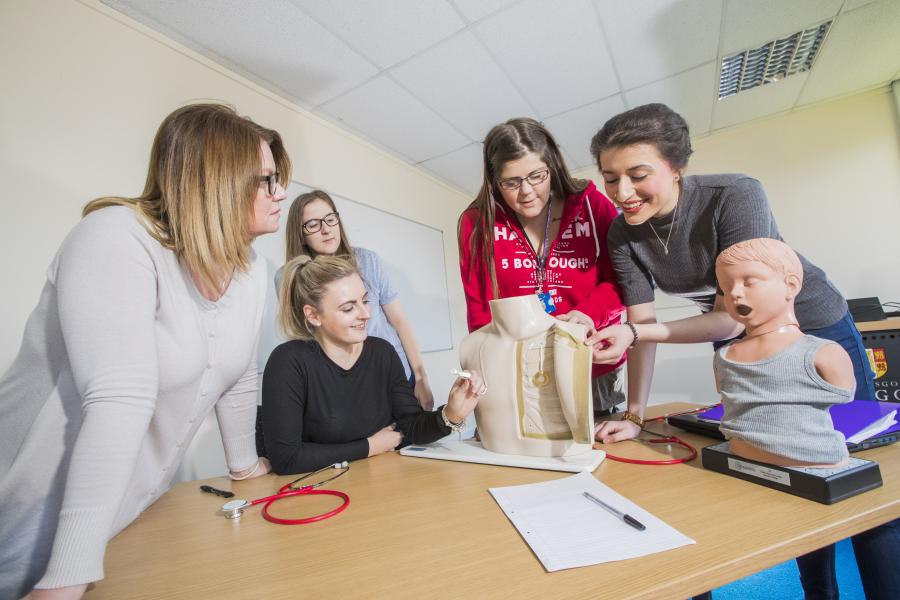
EXPLORE MORE IN NURSING
Nursing is highly rewarding and is a profession constantly evolving to address the needs of contemporary society. Our Bachelor of Nursing degrees will provide you with the knowledge and skills you need to provide evidence-led and compassionate nursing care.


My name is Kavisha Prince Anthony, and I always had a dream of studying abroad. Thankfully, that dream came to life since I applied to the Study Advisor. I was able to receive my visa within four days. I also had some visa refusals in the past; I had about six UK visa refusals in the past, but thankfully, it was not an issue since the Study Advisor was able to make things work this time. I highly recommend Study Advisor for your dreams of going abroad, whether it be the UK or any other European country there is.