
About This Course
You’ll specialise in understanding the structure of the human brain, and how it functions to enable perception, thought, emotion, language and behaviour. You’ll analyse what happens when the brain is damaged or impaired, e.g. in head injury, stroke or Alzheimer’s disease and how such patients can be helped through rehabilitation. You’ll become acquainted with advanced techniques such as functional magnetic resonance imaging (fMRI) and event-related potentials (ERPs) for observing brain activity and diagnosing problems.
On this course, as well as gaining a thorough understanding of the broad range of topics relevant to modern day psychology, you’ll specialise in neuropsychology, and will develop an in-depth understanding of how the brain and the nervous system influence human thought, emotion, language and behaviour. During the course you’ll become acquainted with advanced techniques such as functional magnetic resonance imaging (fMRI) and event-related potentials (ERPs) for observing brain activity and learn how developments in research technology have supported our developing understanding of the brain – its structures and functions. You’ll learn about biological factors across the lifespan, neural encoding, learning and representation, as social beings how other people are represented in the brain but also how we perceive ourselves. You may also learn about what happens when the brain is damaged or impaired, for example in head injury, or stroke, not only how these conditions affect patients but also how patients can be rehabilitated.
Psychology at Bangor University was founded in 1963 and is one of the UK's oldest and largest psychology departments. We regularly rank among the top 10 in the National Student Survey for overall student satisfaction and with over 1,000 students we're also one of the largest departments in the UK. Not only are we highly ranked for our teaching but we also have a global reputation for the quality of our research. In the most recent Research Exercise Framework, we ranked in the top 20 in the UK with 89% of our research considered either 'Internationally Excellent' or 'World leading'. This research feeds directly into our teaching ensuring a fresh, vibrant learning experience and a large and varied range of modules studied with academics who have an international reputation in their specialist area.
We have a cosmopolitan feel and a global outlook that attracts staff and students from all over the world to work and study with us. A key aspect of our success is our focus on both the academic and pastoral sides of the student experience and this effort is led by academics in the teaching team who provide high levels of support to our students. All of this combines to provide you with what we believe is a uniquely supportive, exciting and rewarding environment in which to study Psychology with Neuropsychology.
Why choose Bangor University for this course?
- 100% Student Satisfaction (National Student Survey 2020).
- 2nd (of 115) for Course satisfaction (Guardian Good University Guide 2021).
- Top 20 for Research Quality (Complete University Guide 2021).
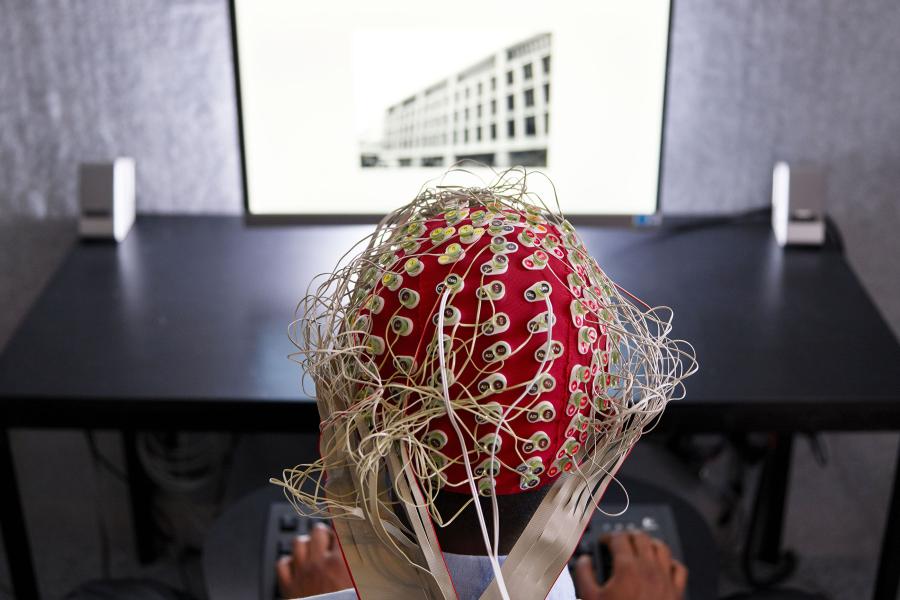
- Specialist research labs including an MRI scanner, TMS, ERP, EEG and a Brain Anatomy lab.
- Expertise in neuroscience and an exciting array of neuropsychology dissertations e.g. how brains process information from prosthetic limbs or how brain activity differs with different languages.
Course Content
You’ll learn through a variety of lectures, seminars, tutorials, and practicals as well as self-guided learning. As an undergraduate student, you’ll gain an excellent grounding in various research methodologies used in the field by participating in current cutting-edge research being conducted in the school. We make extensive use of technology in order to enhance the learning experience including recording podcasts, and an innovative range of online assessments that, amongst other advantages, provide instant feedback. An increasing number of our modules can be followed through the medium of Welsh and students can choose to have a Welsh speaking tutor and complete their project in Welsh.
There is a wide range of continuous assessment on offer across the modules including essays, weekly homework, multiple choice tests, presentations, blogs, quizzes etc. throughout each semester and many modules include end of semester examinations.
What will you study on this course?
In your third year you will carry out a major research project in the area of neuropsychology. The project will be individually supervised by a member of staff who is a specialist in the appropriate research field giving you the opportunity to exercise your skills and knowledge alongside an expert. Our students regard the project as one of the most challenging, but also most rewarding elements of their course and our graduates have amongst the most highly developed research skills of any UK psychology graduates.
In years 1 and 2 you’ll take compulsory modules as for the BSc Psychology degree. These will give you a strong foundation in the wide-ranging reach of psychology before you go on to specialise in your third year where you’ll take at least half of your taught credits in neuropsychology specific modules.
Each year you study a total of 120 credits and the modules build up over the years to provide both breadth and depth of understanding with a focus on neuropsychology.
All graduates who achieve at least a 2:2 will be eligible for Graduate Based Chartered Membership (GBC) of the British Psychological Society (BPS).
Your Research
We put great emphasis on developing your research skills. Right from the start of your course you’ll begin to build an understanding of how to undertake research and you’ll also act as a participant in our ongoing research programmes. In this way, you’ll gradually acquire the skills you need to design and conduct your own research project in year 3. Your project will be related to neuropsychology in an area that fits with the research strengths of our staff. Recent projects include studies of how the brain attends to stimuli and perceives objects, how the brain responds to pain, how the brain perceives social interactions and developing a detailed understanding of cerebral physiology. We have a wide range of specialist research laboratories including MRI, ERP, TMS, Eye tracking, etc.
Facilities
General University Facilities
Library and Archive Services
Our four libraries provide a range of attractive study environments including collaborative work areas, meeting rooms and silent study spaces.
We have an extensive collection of books and journals and many of the journals are available online in full-text format.
We house one of the largest university-based archives not only in Wales, but also the UK. Allied to the Archives is the Special Collections of rare printed books.
Learning Resources
There is a range of learning resources available, supported by experienced staff, to help you in your studies.
The University’s IT Services provides computing, media and reprographics facilities and services including:
- Over 1,150 computers for students, with some PC rooms open 24 hours a day
- Blackboard, a commercial Virtual Learning Environment, that makes learning materials available on-line.
Careers
This course focuses on Psychology with Neuropsychology so is particularly suitable for students who want to pursue this particular career track. It is also suitable for students who want to follow any of the main psychological professions (clinical psychology, educational psychology, counselling psychology, health psychology, etc). In addition, there are careers open to graduates and postgraduates from any discipline. These include, careers in management training, accountancy, teaching, nursing, social work, the police and the armed forces. Employers are usually looking for general or transferable skills, and a psychology degree provides a unique combination of these as it is both a literate and numerate discipline.
Employability is a key theme of all the psychology programmes you can follow at Bangor and we have embedded a large number of opportunities within our degrees that provide you as strong a CV as possible and equip you with a host of transferable skills that are relevant to both psychology and non-psychology related careers.
Previous graduates from the BSc Psychology with Neuropsychology course have gone into a wide range of career paths including but not limited to, researchers and academics, data scientists in industry, assistant and clinical psychologists.
The simple fact that you’ll graduate from an internationally renowned, research intensive psychology department adds additional value to your degree and improves your employability.
Further details on the exciting careers open to graduates of this course can be found on the BPS website.
EXPLORE MORE IN PSYCHOLOGY
Psychology is the scientific study of how people behave, feel, think and learn. As a science and as a profession, Psychology makes a difference to people in the real world, by improving quality of life across a wide range of areas. We are proud of our strengths in teaching, learning and research, ensuring that you’ll be learning the science and application of psychology from world class researchers and lecturers
Foundation Year
A 'with Foundation Year' option is available for this course. Apply for Psychology (with Foundation Year).
What is a Foundation Year course?
If you don’t have the required qualifications for the degree-level course or are looking to re-enter education after time away from study, then a Foundation Year Programme might be the right choice for you.
The Foundation Year is an excellent introduction to studying this subject at university and will provide you with the knowledge, skills and confidence required to go on to study this course at degree-level.
When you have successfully completed the Foundation Year, you can progress on to the first year of this degree-level course.


My name is Kavisha Prince Anthony, and I always had a dream of studying abroad. Thankfully, that dream came to life since I applied to the Study Advisor. I was able to receive my visa within four days. I also had some visa refusals in the past; I had about six UK visa refusals in the past, but thankfully, it was not an issue since the Study Advisor was able to make things work this time. I highly recommend Study Advisor for your dreams of going abroad, whether it be the UK or any other European country there is.