
About This Course
The past can be exploited; it can be corrupted; it can be used to create myths, legends and to forge identities. This course is ideally suited to anyone interested in learning about the past and how it is represented (or even misrepresented) by the heritage industry. You will explore historical and archaeological evidence and differing interpretations of it. Practical and transferable skills gained will prepare you for a variety of career options.
Why choose Bangor University for this course?
- The local area is steeped in history (including UNESCO World Heritage Sites) and provides a resource for fieldwork as well as a superb location for study.
- Excellent opportunities to gain experience of working with local and national archaeological and heritage organisations.br> We have experts in all fields of History from the Middle Ages to the twentieth century, who work principally on Britain, Europe and the United States of America.
Course Content
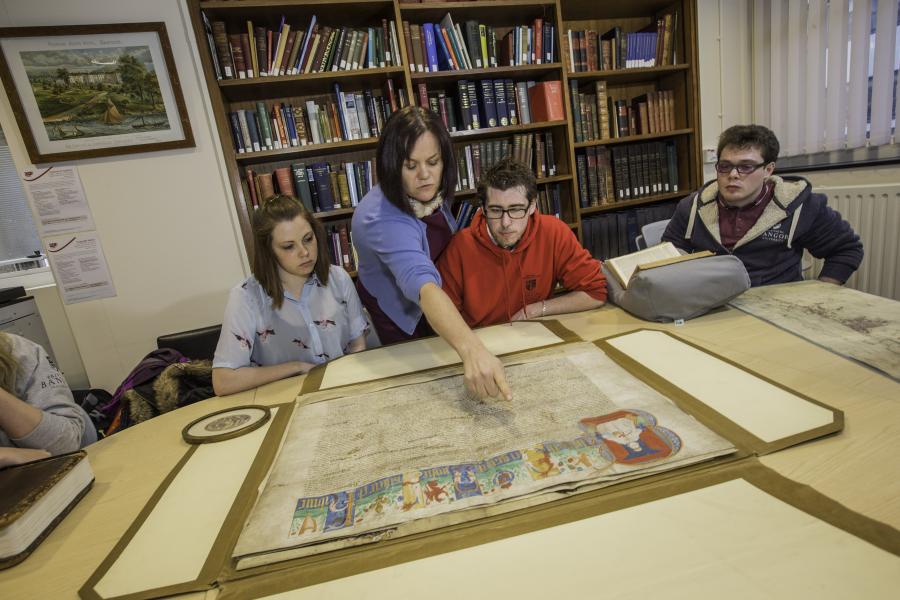
During this degree you will learn through a variety of taught lectures, seminars, and practical workshops. Fieldtrips to visit archaeological sites, museums and other places of interest are an important part of the teaching experience. In the first year you will have around 5 trips to visit local monuments. In the second and third years the field trips vary in length and nature and include local sites, as well as trips to elsewhere in Britain and Ireland. You will also go on training excavations and carry out other practical post-excavation work. Outside this time, you will complete essays, analysis exercises, prepare for seminars and carry out research. Throughout the course you will be supported by teaching staff.
In the first year, you will be assessed through written work and examinations. In the second and third years there is a mixture of written work, examinations, oral presentations, and portfolios - with a number of courses assessed through coursework only. The dissertation forms one-third of the assessment in the final year.
Facilities
Henfaes Research Centre
Formal training in archaeological fieldwork is carried out the Universities Henfaes Research Centre. Henfaes Research Centre is the Universities excellent field facility, located about 7 miles from Bangor and is 252 hectares in size. It offers unrivalled opportunities to study diverse environments from sea-level to amongst the highest land in Snowdonia.
General University Facilities
Library and Archive Services
Our four libraries provide a range of attractive study environments including collaborative work areas, meeting rooms and silent study spaces.
We have an extensive collection of books and journals and many of the journals are available online in full-text format.
We house one of the largest university-based archives not only in Wales, but also the UK. Allied to the Archives is the Special Collections of rare printed books.
Learning Resources
There is a range of learning resources available, supported by experienced staff, to help you in your studies.
The University’s IT Services provides computing, media and reprographics facilities and services including:
- Over 1,150 computers for students, with some PC rooms open 24 hours a day
- Blackboard, a commercial Virtual Learning Environment, that makes learning materials available on-line.
Careers
The complementary nature of these disciplines will enable you to pursue a career in the heritage industry by means of the practical and theoretical skills acquired in heritage, coupled with a clear understanding of the archaeological and historical contexts.
Past graduates have progressed into careers working for, for example, Archaeological Units, Archaeological Trusts, museums, CADW (Historic Environment Service of the Welsh Government). You will also possess valuable transferrable skills which are fundamental requirements for careers in many other employment sectors, including: the public sector, teaching, law, journalism, management, and tourism.
Year 2 and 3 students are provided with the opportunity to complete work-placement modules, which can be carried out in the university or through external organizations. These are assessed as part of the final degree. The programme enhances employability prospects and offers an insight into the type of employment opportunities a degree in history or archaeology offers. Students have undertaken placements in a wide range of workplaces, including archives, archaeological units, museums, and heritage centres.
EXPLORE MORE IN HISTORY, ARCHAEOLOGY AND HERITAGE
History, Archaeology and Heritage are complementary subjects – which together provide a richer understanding of past peoples and societies. At Bangor we offer a range of courses that allow you to study one or more of these.
Placement Year
This course is available with a Placement Year option where you will study for 1 additional year. The Placement Year is undertaken at the end of the second year and students are away for the whole of the academic year.
The Placement Year provides you with a fantastic opportunity to broaden your horizons and develop valuable skills and contacts through working with a self-sourced organisation relevant to your degree subject. The minimum period in placement (at one or more locations) is seven calendar months; more usually you would spend 10-12 months with a placement provider. You would normally start sometime in the period June to September of your second year and finish between June and September the following year. Placements can be UK-based or overseas and you will work with staff to plan and finalise the placement arrangements.
You will be expected to find and arrange a suitable placement to complement your degree and will be fully supported throughout by a dedicated member of staff at your academic School and the University’s Skills and Employability Services.
You will have the opportunity to fully consider this option when you have started your course at Bangor and can make an application for a transfer onto this pathway at the appropriate time. If you have any questions in the meantime, please get in touch.


My name is Kavisha Prince Anthony, and I always had a dream of studying abroad. Thankfully, that dream came to life since I applied to the Study Advisor. I was able to receive my visa within four days. I also had some visa refusals in the past; I had about six UK visa refusals in the past, but thankfully, it was not an issue since the Study Advisor was able to make things work this time. I highly recommend Study Advisor for your dreams of going abroad, whether it be the UK or any other European country there is.