
About This Course
You’ll learn about what sport and exercise psychologists do, how they do it, and why. You’ll learn from expert staff about a range of topics from how sport performers thrive under pressure to what motivates exercisers to engage in physical activity. You’ll also complete a novel research project that enhances what we know about the application of psychological factors related to exercise and sport preparing you for a career as a sport psychologist.
Are you thinking of becoming a sport and exercise Psychologist?
Whether you are interested in working with elite and professional athletes and teams to improve their performance or are more interested in how regular people learn how to enjoy sports and learn to stick to an exercise program then this is the course for you.
Sports & exercise psychology is the study of the psychological factors that influence sports, athletic performance, exercise, and physical activity. Sports & exercise psychologists investigate how psychological factors influence elite athletes’ ability to perform under pressure and how participating in recreational sport and exercise can improve health, mental health and wellbeing.
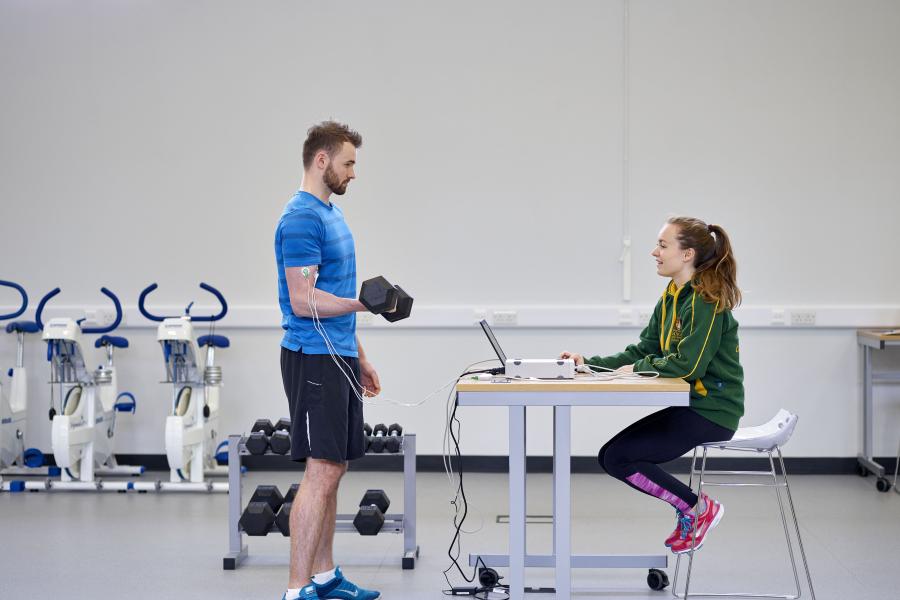
An unusual focus of this course at Bangor is its examination of psychophysiological factors, like brain imaging & in-depth heart rate monitoring, to better understand how psychological and physiological processes interact with, and relate to, the sport and exercise behaviour of elite athletes and recreational exercisers. As you progress through the course there are many areas of specialism that you can explore including more unusual aspects such as such as the psychology of addictive behaviours, neuroscience and counselling approaches and more traditional areas such as the influence of stress and anxiety on performance, psychological skills, the influence of personality and individual differences on health and performance and how to design and evaluate interventions.
This course is accredited by the British Psychological Society (BPS) to provide you with Graduate Basis for Chartered membership of the Society, the necessary first step to any career as a psychologist in the UK and of course of particular relevance to sport and exercise psychology careers.
Learn from the best
You’ll be taught by chartered psychologists from the forefront of the discipline. Sport, Health and Exercise science staff have worked, and currently do work with numerous Olympic Sports, professional sport, the military and the NHS. In addition, the department currently houses the largest concentration of performance focused psychology researchers anywhere in the world and many of the subjects taught on this course are delivered by staff in psychology who also have international reputations in their specialist areas.
North Wales offers a stunning natural environment for your studies, and our department, which was established in 1978, is proud to call itself one of the original and longest serving Sport and Exercise Science providers in the world.
Why choose Bangor University for this course?
- 5th for Research Quality (Complete University Guide 2021).
- Internationally renowned Institute for the Psychology of Elite Performance (IPEP) boasting state-of-the-art sports psychology labs.
- Top 10 for Value Added shows we help each student achieve their potential (Guardian Good University Guide 2021).
- Staff provide sport psychology and leadership expertise to bodies including: GB Telemark Ski Team, England and Wales Cricket Board, UK Sport, Sport Wales, Ministry of Defense, Lloyds TSB, Ericsson.
Course Content
Students will typically have one or two hours of lectures per week for each module as well as laboratory time, seminars and tutorials. This direct contact time will be tied with student-centred learning such as reading, writing essays and reports, gathering information and data, working on group projects and preparing verbal and poster presentations. These activities form the basis of your assessment, along with examinations, case studies and critiques of research.
25% of students’ time is spent in lectures, seminars and lab practical's. We keep most of our lectures, seminars and lab class sizes small:
- Lectures: 30-150
- Seminars: approx. 12
- Laboratory practical's: approx. 25
This approach allows our students to have closer contact with lecturers and tutors, and all our students have access to regular one-to-one meetings with staff.
What will you study on this course?
In year 1 you will study the foundations of sport and exercise psychology, physiology, research methods and core aspects of psychology such as the role of the brain and mind. You can also undertake 2 weeks work experience focused on an area of interest to you, develop your professional skills or diver deeper into some aspects of positive psychology.
Year 2 focuses on the key elements required for BPS accreditation including cognitive, social, developmental and biological psychology alongside content in sport and exercise psychology and the psychophysiology of sport and exercise. You’ll also further hone your research methods skills and begin the process of developing your research project, where you’ll develop an original research question focusing on an area of particular interest to you.
In year 3 the major focus is your research project, where you’ll collect and analyse data relating to a novel research question and present the findings in a variety of formats. You’ll also take an in-depth look at topics such as stress and performance, personality and individual differences and look at ways of intervening with athletes to improve performance.
Facilities
This course has very strong links with the department of psychology which has a a wide range of specialist research laboratories including MRI, ERP, TMS, Eye tracking, etc.
Careers
The BSc Sport and Exercise Psychology degree is accredited by the British Psychological Society (BPS) to provide students with Graduate Basis for Chartered membership of the Society, the necessary first step in a career as a psychologist in the UK. It also provides excellent preparation for careers in sport science and the sport, fitness and health industries as well as being suitable for progression into any field of psychology.
Where to from here? Routes to employment
The British Psychological Society (BPS) accredits the course. It provides you with the opportunity to gain graduate basis for chartered membership (or GBC) which is essential for starting any career in psychology. After completing the course you will be eligible to apply to the BPS for GBC. This is the first stage on the road to becoming a chartered psychologist or a Health Care professions Council registered practitioner psychologist Other areas of possible employment based on the skills developed on the course include:
- All avenues of psychology professions
- Teacher/lecturer
- Sport and exercise Scientist
- Researcher
- Psychology Assistant
- Managerial positions
- Working in Health promotion or health behaviour
Many students also go on to study for a masters degree, for example the MSc Sport and Exercise Psychology programme at Bangor which is BPS accredited for graduates holding GBC from their undergraduate degree.
EXPLORE MORE IN SPORT, HEALTH AND EXERCISE SCIENCES
Our research-led curriculum covers the core Sport, Health and Exercise Science topics of physiology, psychology, exercise, health and medicine, biomechanics and effective coaching. Our expertise and high calibre teaching will help you gain the knowledge and skills you need for a career in the expanding sport, health, exercise and adventure markets.
Foundation Year
A 'with Foundation Year' option is available for this course. Apply for Sport and Exercise Science (with Foundation Year).
What is a Foundation Year course?
If you don’t have the required qualifications for the degree-level course or are looking to re-enter education after time away from study, then a Foundation Year Programme might be the right choice for you.
The Foundation Year is an excellent introduction to studying this subject at university and will provide you with the knowledge, skills and confidence required to go on to study this course at degree-level.
When you have successfully completed the Foundation Year, you can progress on to the first year of this degree-level course.


My name is Kavisha Prince Anthony, and I always had a dream of studying abroad. Thankfully, that dream came to life since I applied to the Study Advisor. I was able to receive my visa within four days. I also had some visa refusals in the past; I had about six UK visa refusals in the past, but thankfully, it was not an issue since the Study Advisor was able to make things work this time. I highly recommend Study Advisor for your dreams of going abroad, whether it be the UK or any other European country there is.