
About This Course
The MSci is an extended undergraduate programme that allows students to graduate either with a BSc (Hons) at the end of Year 3 or with a Masters at the end of Year 4. The School of Sport, Health and Exercise Sciences offer this course.
This degree concentrates on the overall aspects of sport and exercise and their importance in promoting healthy lifestyles.
We place a strong emphasis on applying theoretical knowledge to performance and all students, regardless of the course they are on, undertake a Research Skills module. This gives them the opportunity to integrate the knowledge they have accumulated in an individual Research Project during their MSci year. Both these modules are compulsory.
Research Skills – This covers three main topics; quantitative research design, the analysis of group differences and regression analyses using quantitative methods and qualitative research methods and analysis.
Students read series of scientific papers to develop their critical understanding of research design, including formulating a question, generating a hypothesis, study designs, sampling methods, ensuring validity and reliability, and good dissemination practices. Both original investigations and review studies will be included. The second topic involves using a wide variety of quantitative methods to analyse group differences and regression analyses. The qualitative part of the module will address the different philosophical positions underpinning quantitative and qualitative research; data collection methods, including interviews, focus groups and observational methods; and qualitative data analysis, including thematic content analysis, grounded theory and discourse analysis.
Research Project – This is an independent piece of research, and acts as the culmination of the academic challenges faced by the student. The module comprises 60 credits (ie equivalent to three double modules) and will formally equate to some 600 hours of student time.
Students work closely with their supervisor to develop a research project. Academic supervisors are leaders in their field of study and provide excellent research training and guidance throughout this process. Once an appropriate research question is agreed, students will implement a research design and method suited to the area of enquiry.
Multi-disciplinary and interdisciplinary studies, which might involve the student’s ongoing sport/exercise experience, will be encouraged. Each topic will normally involve data collection, analysis and interpretation and allow students to demonstrate their powers of imagination, initiative, independence and time management. Students are expected to show a thorough knowledge of the relevant sources of information and the ability to use them with discrimination; to provide full references; to exercise sound and independent judgment; to structure work logically and to express themselves with clarity and precision.
Why choose Bangor University for this course?
- 5th (of 76) for course satisfaction - Guardian Good University Guide 2020
- 5th in the UK for Research Quality – Complete University Guide 2020
- 2nd in the UK for Value Added demonstrating our ability to help each student achieve their best possible outcome - GGUG 2020
- We are internationally renowned for our work in sport science and you’ll be studying at a research-led Sport Science School that was 7thin the UK in the most recent governmental assessment - REF 2014
- In the Teaching Excellence Framework, Bangor University was the 1st university in Wales to be awarded Gold
- The School has close links with UK Sport, the England and Wales Cricket Board, England Rugby and the Ministry of Defence (to name a few)
- This degree draws on expertise from staff who are leading researchers and clinicians in their fields and we have a number of Honorary Research Fellows who are senior consultants with the local NHS Trust
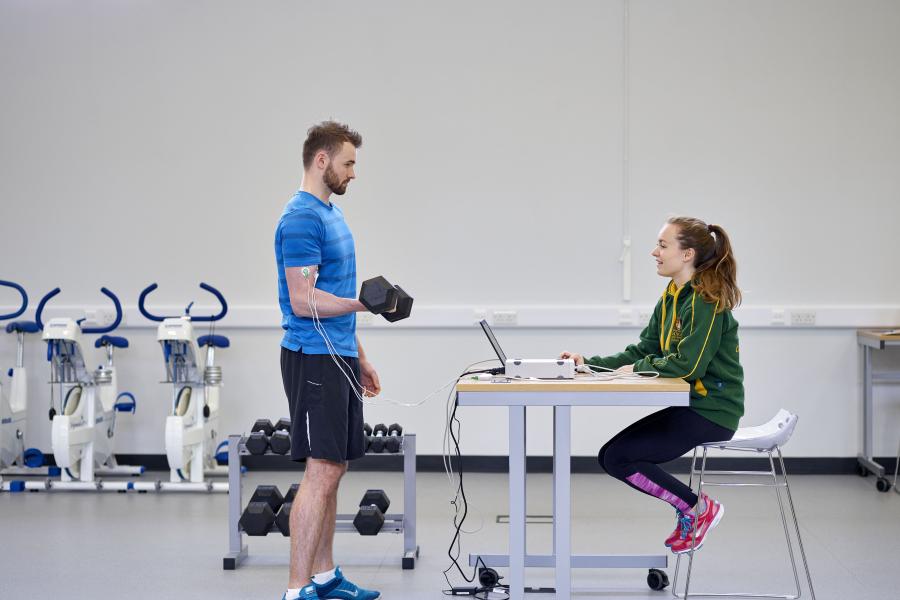
- Laboratory practical’s give students hands-on experience to enable them to put theory into practice
Course Content
Students will typically have one or two hours of lectures per week for each module as well as laboratory time, seminars and tutorials. This direct contact time is tied with student-centred learning such as reading, writing essays and reports, gathering information and data, working on group projects and preparing verbal and poster presentations. These form the basis of your assessment, along with examinations, case studies and critiques of research.
25% of students’ time is spent in lectures, seminars and lab practicals. We keep our lectures, seminars and lab class sizes small:
- Lectures: 30-150
- Seminars: approx. 12-15
- Laboratory practicals: approx. 25
This means that our students have closer contact with lecturers and tutors, and all our students have access to regular one-to-one meetings with staff.
Careers
All postgraduate taught applicants (Home/EU /International, full-time and part-time) are eligible to APPLY to become a Graduate Assistant (GA).
Graduate Assistants are paid to work with academic staff in a range of teaching, learning and assessment activities to support undergraduate student learning for up to 60 hours each academic year.
EXPLORE MORE IN SPORT, HEALTH AND EXERCISE SCIENCES
Our research-led curriculum covers the core Sport, Health and Exercise Science topics of physiology, psychology, exercise, health and medicine, biomechanics and effective coaching. Our expertise and high calibre teaching will help you gain the knowledge and skills you need for a career in the expanding sport, health, exercise and adventure markets.


My name is Kavisha Prince Anthony, and I always had a dream of studying abroad. Thankfully, that dream came to life since I applied to the Study Advisor. I was able to receive my visa within four days. I also had some visa refusals in the past; I had about six UK visa refusals in the past, but thankfully, it was not an issue since the Study Advisor was able to make things work this time. I highly recommend Study Advisor for your dreams of going abroad, whether it be the UK or any other European country there is.