
About This Course
The past has many dimensions and there are many routes to it. Archaeology, which deals with material evidence, artefacts, monuments and buildings, is one avenue, while history, traditionally derived from written sources, is another. Through studying the history and archaeology of Wales (and the archaeology of Britain and Ireland) as the main core of this degree, you will gain an understanding of the development of Wales over the centuries, of the changing nature of society and settlement and of the historical context of contemporary Wales.
Why choose Bangor University for this course?
- Bangor is the leading centre for the study of the history of Wales and our staff have made notable contributions to research in Welsh archaeology.
- Our range of modules will be particularly attractive if you are interested in ancient and pre-modern society. We offer the chance to study topics not available anywhere else such as the impact of the Renaissance on Wales.
- The School has an excellent teaching reputation.
- Our local area is exceptionally rich in monuments of all periods. Field-trips take advantage of this.
- Our local museum enables you to gain first-hand experience in handling artefacts - an opportunity not widely offered elsewhere.
- In the second year you have the chance to develop skills in practical archaeology, such as surveying and computing, and go on a work placement.
Course Content
For more on studying degree courses see our Study at Bangor section.
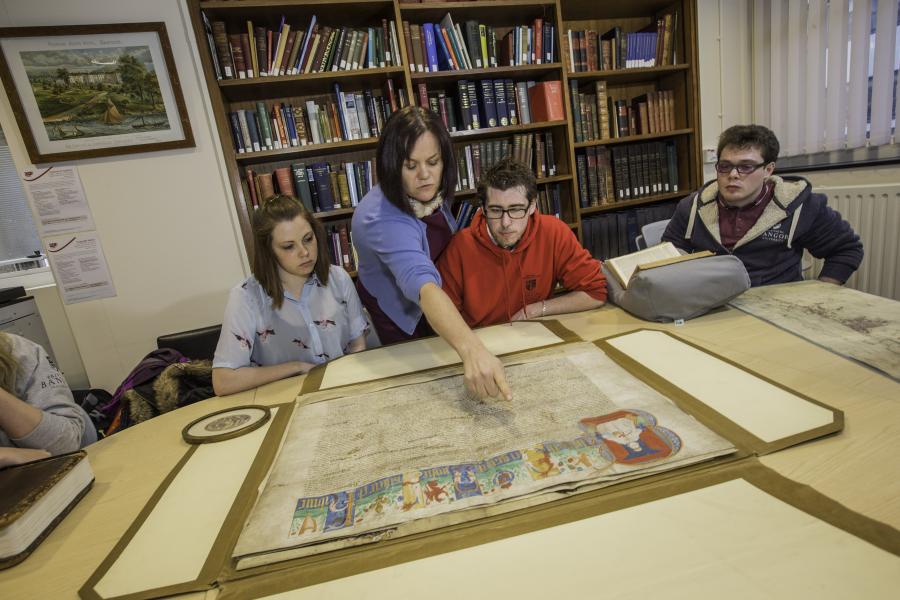
You will have about 12 hours of lectures, seminars and tutorials each week. Teaching on the Welsh History modules tends to be in small groups. A very close atmosphere develops, as most students follow a similar pattern of optional modules, and are taught largely by the same staff. We organise a range of field trips which may be afternoons, whole days or a whole weekend. You will also have the opportunity to go on archaeological excavations and do other practical work. Outside formal teaching you will read, complete essays and prepare presentations. A workplace module is available allowing you to gain valuable experience working in a museum, archive or archaeological unit.
Assessment is a combination of written work, essays, examinations and portfolios. The dissertation in the final year is a major piece of project work involving research carried out under the close supervision of your tutor.
Careers
This course provides specialist knowledge and a range of analytical and presentational skills which will enable you to tackle a variety of career options centring on culture and heritage especially, but not exclusively, in Wales e.g. in archaeology units, museums and heritage centres, including the National Trust, as well as a range of directly transferable vocations. Graduates have in recent years gained careers in local government, conservation and teaching, and some have taken further training to become professional archaeologists.
A degree in archaeology equips students with a wide range of skills necessary to enter into a career in heritage, archaeology or the museums sector. It also provides key transferrable skills, such as:
- The ability to collate, analyse and contextualise data-sets
- An ability to critically review the literature and formulate logical and structured arguments
- Develop written and presentation and practical archaeological skills as well as working as part of a team.
- Writing and editorial skills
- An appreciation of the complexity and diversity of situations, events and past mentalities
- Experience gained from carrying out and completing a major research project in the third year – the dissertation
- A range of practical skills acquired through survey, excavation and the study of material evidence
- Good IT skills
- Time management skills
These transferable skills are fundamental to other employment sectors, such as the public sector, teaching, tourism, law, accountancy and management.
Work experience opportunities at Bangor University
Year 2 and 3 students are provided with the opportunity to complete work-placement modules, which can be carried out in the university or through external organizations. These are assessed as part of the final degree. The programme enhances employability prospects and offers an insight into the type of employment opportunities a degree in history or archaeology offers. Students have undertaken placements in a wide range of workplaces, including archives, archaeological units, museums and heritage centres.
For more information on employment opportunities in archaeology, please click here.
It is now possible to supplement your degree with the Bangor Employability Award. For more information on this award, please click here.
EXPLORE MORE IN HISTORY, ARCHAEOLOGY AND HERITAGE
History, Archaeology and Heritage are complementary subjects – which together provide a richer understanding of past peoples and societies. At Bangor we offer a range of courses that allow you to study one or more of these.


My name is Kavisha Prince Anthony, and I always had a dream of studying abroad. Thankfully, that dream came to life since I applied to the Study Advisor. I was able to receive my visa within four days. I also had some visa refusals in the past; I had about six UK visa refusals in the past, but thankfully, it was not an issue since the Study Advisor was able to make things work this time. I highly recommend Study Advisor for your dreams of going abroad, whether it be the UK or any other European country there is.