
About This Course
This course will teach you how to apply ecological sciences to the real-world needs of sustainable management and natural resource conservation across terrestrial and marine ecosystems. Current thinking in environmental management recognises the need for holistic practices which acknowledge the interrelatedness of the terrestrial and aquatic environments. As well as studying fundamental ecology, you will develop skills that allow you to assess the impact of policy decisions on management. You will be well prepared for the future job market as public and private sector organisations are increasingly paying attention to the sustainability and environmental impact of their operations. We offer a wide range of optional modules including forest ecology, environmental Policy, freshwater ecosystems, wildlife ecology and conservation, forest ecology, ornithology, primatology, Human aspects of conservation.
You will have the option of going on a weeklong field course to Tenerife or a longer tropical field course to Uganda. Our location, between the Menai Strait and Snowdonia National Park, offers unrivalled opportunities for learning about ecology, conservation and the natural environment outside the class room. This course is packed with field trips and practical sessions.
We have close links with many of the local conservation organisations including Snowdonia National Park Authority, Natural Resources Wales and the British Trust for Ornithology which help our students gain understanding of conservation practice.
Why choose Bangor University for this course?
- TV presenter Steve Backshall is now part of our teaching team.
- This course is the only one of its kind offered in the UK.
- Our location is ideal for fieldwork – we are just metres from the seashore, with the mountains of Snowdonia National Park providing a spectacular backdrop to the city.
- Close links with environmental bodies e.g. The Snowdonia Society, Natural Resources Wales and the British Trust for Ornithology.
Course Content
The modules we offer on this degree use a wide variety of teaching methods ranging from lectures, practicals and fieldwork to seminars and tutorials. Seminars and tutorials concentrate on problem solving, study skills development and reinforcing material taught in lectures; their relaxed and informal atmosphere also encourages lively debate over current and contentious issues. In your first year you will take a number of compulsory modules which will set the foundations of your degree. In the second and third year you will be able to choose an increasingly higher proportion of the modules to suit your interests. This will also allow you to gain a set of skills and expertise that are unique to you. We asses you using a variety of methods with an average split of 60% coursework and 40% examination. All our modules make extensive use of our virtual learning environment, which provides direct access to learning resources, course documents and lecture notes. If you opt for the placement year, you will spend your third year working with a relevant organisation gaining valuable career experience.
What will you study on this course?
Year 1 + 2
You will study 120 credits in each year of this course, through a range of lectures, tutorials, seminars and fieldwork. Our courses are modular. some compulsory, others optional, allowing you to expand your studies into new areas or develop specialisms.
Final Year
You will take marine conservation and exploitation as a compulsory module, and also work with a supervisor to design and carry out some original research. There is a wide range of optional modules including forest ecology, environmental policy, freshwater ecosystems, wildlife ecology and conservation, forest ecology, ornithology, primatology, human aspects of conservation. You have the option of going to Tenerife or Uganda for a week-long field course.
Facilities
General University Facilities
Library and Archive Services
Our four libraries provide a range of attractive study environments including collaborative work areas, meeting rooms and silent study spaces.
We have an extensive collection of books and journals and many of the journals are available online in full-text format.
We house one of the largest university-based archives not only in Wales, but also the UK. Allied to the Archives is the Special Collections of rare printed books.
Learning Resources
There is a range of learning resources available, supported by experienced staff, to help you in your studies.
The University’s IT Services provides computing, media and reprographics facilities and services including:
- Over 1,150 computers for students, with some PC rooms open 24 hours a day
- Blackboard, a commercial Virtual Learning Environment, that makes learning materials available on-line.
Careers
Our graduates have gone on to work as environmental managers, ecologists or conservation advisors in terrestrial and aquatic contexts, in the UK and overseas. Others have gone on to further study and research. It is possible to take the course as either a three-year degree or over four years with a placement year working with a relevant conservation organisation in the UK or overseas.
EXPLORE MORE IN OCEAN SCIENCES
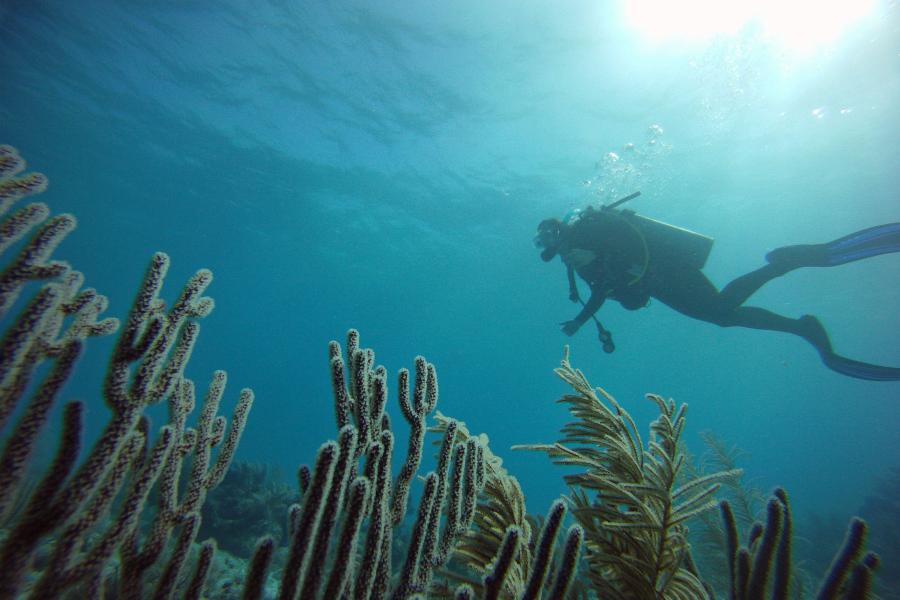
Ocean Science at Bangor is unique in encompassing the study of all aspects of the global marine environment, from estuaries and coasts to the deep ocean. We are one of the largest university centres teaching marine sciences in Britain and one of the biggest in Europe.
Foundation Year
A 'with Foundation Year' option is available for this course. Apply for Environmental Science (with Foundation Year).
What is a Foundation Year course?
If you don’t have the required qualifications for the degree-level course or are looking to re-enter education after time away from study, then a Foundation Year Programme might be the right choice for you.
The Foundation Year is an excellent introduction to studying this subject at university and will provide you with the knowledge, skills and confidence required to go on to study this course at degree-level.
When you have successfully completed the Foundation Year, you can progress on to the first year of this degree-level course.


My name is Kavisha Prince Anthony, and I always had a dream of studying abroad. Thankfully, that dream came to life since I applied to the Study Advisor. I was able to receive my visa within four days. I also had some visa refusals in the past; I had about six UK visa refusals in the past, but thankfully, it was not an issue since the Study Advisor was able to make things work this time. I highly recommend Study Advisor for your dreams of going abroad, whether it be the UK or any other European country there is.