
About This Course
This exciting course course is run by the School of Creative Studies and Media in collaboration with Bangor’s School of Linguistics and English Language. It is aimed at students who want to study Creative Studies (combining some study of: creative writing, film studies, theatre studies, media and journalism studies) with the study of English Language. This course course will equip you with a lively grounding in the practical and critical skills required in these connected fields.
The School of Creative Studies and Media at Bangor specialises in three key areas: Creative Writing, Professional Writing, Journalism; Media, Film and Cinema Studies, New Media; and The Entertainment Industries and Performance Arts. The Institute has research interests in all areas of the Creative Industries, with research programmes running in several key areas: Creative Writing, Critical Writing about Creative Writing, the dimensions and enhancement of Creativity, Publishing and Bookselling, Hollywood and European Cinemas, New and Digital Media, Performance and Nation, Creative Mobile Technologies, Celtic Film and Media, Creative Industries Policy and Management, Children's Picture Books, Postcolonial Film and Media, Creative and Critical Understanding, Digital Versatile Disk, Critical Responsiveness for Creative Practitioners, Interactive Television and Podcasting.
Why choose Bangor University for this course?
- The University has a dedicated Creative Studies and Media building situated overlooking the beautiful Menai Strait and housing its own digital cinema, performance space, creative writing and journalism room and WIFI meeting area. It is also the home of a number of national and international research, development and outreach programmes in the creative studies subjects. The University has a fully equipped media and performance centre, with editing suites, new media suites, a dedicated creative writing and journalism room, production studios and media equipment available to students.
- Bangor has been the location of a number of festivals, is a regular site for visiting creative writers, musicians, film- and media-makers and dramatists, and encourages students to engage widely with such areas as new media, journalism and cross-arts activity.
- We are committed to teaching in small groups and the majority of our modules are delivered through weekly workshops or seminars.
- This course is strengthened by Bangor's close links with many outside bodies, including the international creative writing, film and drama communities, in the USA, Australasia and Europe, and those working in the field of English Language. Staff are practising professionals, who work on joint projects and act as advisers to research councils, arts councils and other bodies.
- Sponsorship and scholarship opportunities are available on a competitive basis.
- Final-year projects are often carried out in collaboration with a company and could include working in a team with students from creative arts degree courses.
Course Content
For more on studying degree courses see our Study at Bangor section.
English Language and Creative Studies offers a balance of practical and critical tasks, introducing students to creative practice studies and the critical study of creative practices in combination with a study of English Language. In Creative Studies you will explore a variety of creative forms, specialising increasingly as you progress through the degree in that form you find most interesting and rewarding (e.g. film, creative writing, theatre and drama, media or new media, journalism). In English Language modules range from speech and language acquisition, to forensic linguistics and bilingualism to discussions of globalisation and the English Language. Much of your study will be done in small group teaching.
What will you study on this course?
A total of 120 credits must be taken in each year. Modules to choose from can include:
Creative Studies
Year 1
60 credits from:
- The Arts of Writing (20)
- Creative Writing: Forms and Techniques (20)
- Introduction to Film History (20)
- The Language of Film (20)
- Introduction to Textual Analysis (20)
- Introduction to Theatre Studies (20)
- Modern Theatre (20)
- IT for Creative Industries (20)
- Introduction to Journalism (20)
- Television and Radio Studies (20)
- Introduction to Media Production (20)
- Media and Popular Music Culture (10)
- Games, Disks and the Web (20)
- My Creative Project (20) (core)
- Saints, Geniuses, Stars (20)
- Creating Fiction (20)
- Animation from Mickey to Manga (20)
- Women on Film (20)
- Poetry and Performance (20)
Year 2
60 credits from:
- Film Theory/Film Culture (20)
- Creative Writing: Showing and Telling (20)
- Creative Writing: The Novel (20)
- Writing for Film and the Media (20)
- Standard Media Production (20)
- Development of Journalism (20)
- Essentials of Multimedia (20)
- Scripts for Theatre and Television (20)
- Development and Censorship of Television (20)
- Directing Theatre (20)
- Styles of Theatre (20)
- Marketing Creativity (20)
- Documentary and Drama (20)
- British Publishing Uncovered (20)
- Developing Multimedia (20)
- Writing for Children (20)
- Creative Project 2 (20)
Year 3
60 credits from:
- Marketing Creative Writing (20)
- Advanced Practical Journalism (20)
- Creative Project 3 (20)
- Writing Hypertext (20)
- Advanced Media Production (20)
- The Films of Alfred Hitchcock (20)
- Stanley Kubrick: Auteur (20)
- Creative Writing and Production 2 (20)
- Creative Writing Dissertation (40)
- PR and Visual Journalism (20)
- Scripts for Theatre and Television (20)
- Development and Censorship of Television (20)
- Directing Theatre (20)
- Styles of Theatre (20)
- British Cinema (20)
- America on Film (20)
- Celtic Film (20)
English Language
Year 1
Core:
- Tools for Language Analysis I (20)
- English in Society (20)
- Tools for Language Analysis II (20)
Year 2
60 credits chosen from:
- Sentence Structure: Syntax (20)
- Variation in English (20)
- Meaning (20)
- Research Methods and Design (20)
Year 3
60 credits chosen from:
- Speech and Language Disorders (20)
- Child Language Acquisition (20)
- History of English (20)
- Language and Gender (20)
- Teaching EFL (20)
- Interactional Pragmatics (20)
- Applied Linguistics TEFL (20)
- Sociolinguistics (20)
- Bilingualism (20)
- Forensic Linguistics (20)
- Discourse Analysis (20)
- English and Globalisation (20)
Modules for the current academic year
Module listings are for guide purposes only and are subject to change. Find out what our students are currently studying on the Creative Studies and English Language Modules page.
Course content is for guidance purposes only and may be subject to change.
Careers
Opportunities at Bangor
The University’s Skills and Employability Service provides a wide range of resources to help you achieve your graduate ambitions.
The Bangor Employability Award (BEA)
With the BEA, you can gain recognition for your extra-curricular activities (e.g. volunteering, clubs and societies, part-time work, etc.)
Internships
Bangor University runs a paid internship scheme within the university’s academic and service departments.
Student Volunteering
Volunteering widens your experience and improves your employability. Find out more about the volunteering on the Students’ Union’s website.
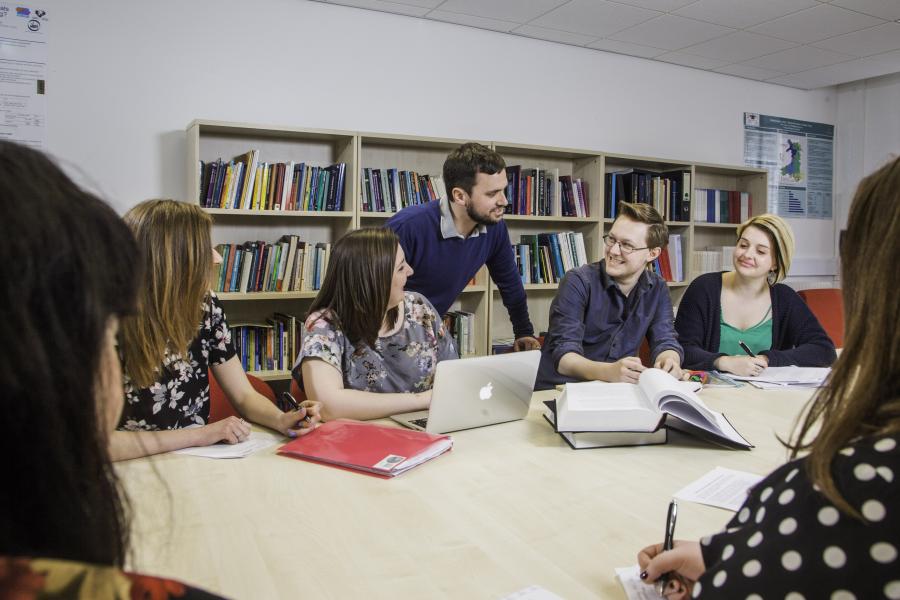
EXPLORE MORE IN LINGUISTICS
Studying linguistics will enable you to learn about, understand and interpret many aspects of human language. At Bangor you will study the ‘science’ behind language, including sounds (phonetics, phonology), words (morphology), sentences (syntax), and meaning (semantics).


My name is Kavisha Prince Anthony, and I always had a dream of studying abroad. Thankfully, that dream came to life since I applied to the Study Advisor. I was able to receive my visa within four days. I also had some visa refusals in the past; I had about six UK visa refusals in the past, but thankfully, it was not an issue since the Study Advisor was able to make things work this time. I highly recommend Study Advisor for your dreams of going abroad, whether it be the UK or any other European country there is.