
About This Course
This course allows you to combine study of the past, with the literature past societies have produced. The provisions in both subjects at Bangor spans from the early medieval period, right through to the contemporary world; and includes study of a range of sources and approaches from the political, cultural and social in history, to a wide range of genres in English (for example Welsh writing in English, dystopian literature, or children’ literature). In the third year there is a chance to develop your own major dissertation topic which can combine insights from both disciplines.
Why choose Bangor University for this course?
- Study in an inspiring area steeped in history and rich in arts & culture.
- Teaching quality (TEF Gold) and Research excellence (REF 2014).
- A flexible course structure - lets you explore and develop your own interests.
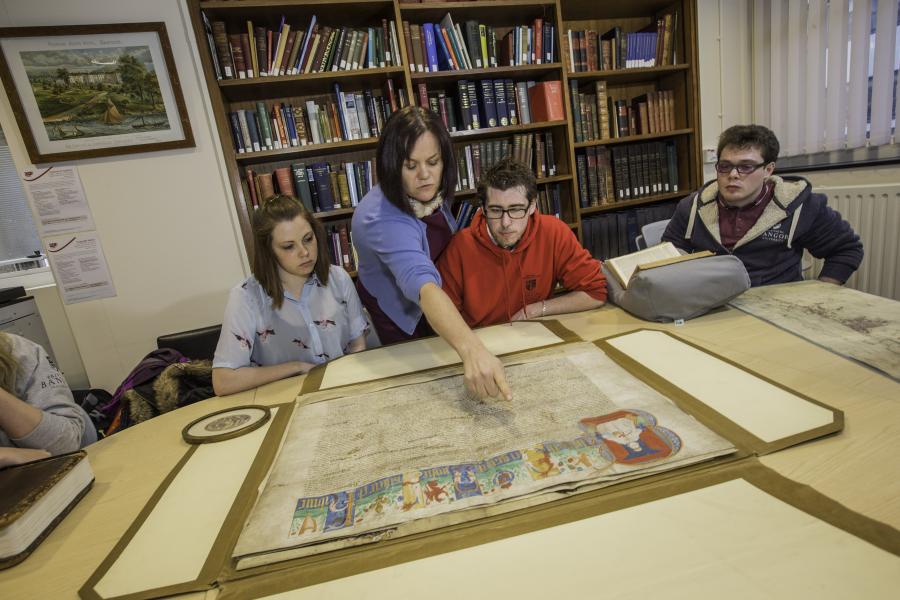
- Excellent library holdings and on-site University archives and special collections.
- Our close links with the university's Arts Centre, Pontio, student societies and local theatres and museums.
Course Content
During your degree you will learn through a variety of small-group seminar classes, fieldtrips, practical workshops, one-to-one tuition, and lectures of between 10 and 50 students. With key historic and World heritage sites on the doorstep, our location gives access to a rich resource of local heritage sites, monuments, and museums. From prehistorical burial mounds to stately homes and castles, this tremendous resource is an integral part of the course and used in our teaching through field trips, practical workshops, and excavations.
In the first year of your History and English Literature degree you will choose from a selection of modules that are intended to provide a flavour of both disciplines. In the second and third year you will have a wide choice of more specialist and thematic modules. This allows you to tailor your degree to your own interests. You will also have an option to research and write a dissertation on a topic of your choice in Year 3.
Alongside classroom teaching and fieldtrips, you will also benefit from a range of other academic and social activities in both Schools. These include student conferences and School journals, quizzes and social occasions, student-led trips and talks. Our students are also able to benefit from University schemes such as ‘Languages for All’ and ‘Welsh for Adults’ (free languages classes in French, German, Italian, Mandarin Chinese, Spanish and Welsh) and the Study Skill Centre.
Outside this time, you will prepare for seminars, carry out research, and complete assignments. Assessment is a mixture of essays, projects, presentations, and examinations. Throughout the course you will be supported by our expert and enthusiastic teaching staff.
Facilities
General University Facilities
Library and Archive Services
Our four libraries provide a range of attractive study environments including collaborative work areas, meeting rooms and silent study spaces.
We have an extensive collection of books and journals and many of the journals are available online in full-text format.
We house one of the largest university-based archives not only in Wales, but also the UK. Allied to the Archives is the Special Collections of rare printed books.
Learning Resources
There is a range of learning resources available, supported by experienced staff, to help you in your studies.
The University’s IT Services provides computing, media and reprographics facilities and services including:
- Over 1,150 computers for students, with some PC rooms open 24 hours a day
- Blackboard, a commercial Virtual Learning Environment, that makes learning materials available on-line.
Careers
Joint honours degrees are very versatile. This degree will enable you to tackle a variety of career options in administration, commerce, management, and other professions. Graduates have in recent years gained careers in museum work, law, teaching and the cultural industries. Many former students have followed these degrees with postgraduate study in History or English Literature, and there are opportunities to pursue your research interests at Bangor. By studying for a degree in History and English Literature you will acquire a wide range of transferable skills, be they academic or personal. History and English Literature graduates are desirable employees due to the variety of skills they develop during the course of their degree.
Year 2 and 3 students are provided with the opportunity to complete work-placement modules, which can be carried out in the university or through external organizations. These are assessed as part of the final degree. The programme enhances employability prospects and offers an insight into the type of employment opportunities a degree in history offers. Students have undertaken placements in a wide range of workplaces, including archives and heritage centres.
EXPLORE MORE IN HISTORY, ARCHAEOLOGY AND HERITAGE
History, Archaeology and Heritage are complementary subjects – which together provide a richer understanding of past peoples and societies. At Bangor we offer a range of courses that allow you to study one or more of these.


My name is Kavisha Prince Anthony, and I always had a dream of studying abroad. Thankfully, that dream came to life since I applied to the Study Advisor. I was able to receive my visa within four days. I also had some visa refusals in the past; I had about six UK visa refusals in the past, but thankfully, it was not an issue since the Study Advisor was able to make things work this time. I highly recommend Study Advisor for your dreams of going abroad, whether it be the UK or any other European country there is.