
About This Course
Studying linguistics enables you to learn about, understand and interpret many aspects of human language. You will study the structure of language, including sounds (phonetics, phonology), words (morphology), sentences (syntax), and meaning (semantics). You will also study the acquisition and use of language. On this joint course you will also develop advanced skills in a modern language, and specialised insights into the culture, society and history that go with it.
Linguistics is the study of how language works and how and why language is used. Linguists look at how people learn, understand and speak language. Linguistics has a theoretical dimension but also an applied dimension – such as language technology, language policy and language in education. You will also have the opportunity to learn about the ways in which different languages are different or similar in terms of their grammar, how society and language go hand-in-hand, and the functions and status that different languages have across the world.
Studying one or more modern languages gives you the practical skills of learning a language, while also letting you explore the cultural, historical and social aspects of speakers of different languages worldwide. In addition to the language learning that takes place in the classroom, there are lots of exciting opportunities for you to boost your language skills and increase your cultural awareness thanks to extra-curricular activities.
Why choose Bangor University for this course?
- Teaching staff are active researchers in a range of theoretical and applied areas relating to linguistics and modern languages.
- You will gain a sound and scientific insight into the structure and use of language.
- Learning facilities include: an extensive collection of books on linguistics and English language, recording and experimental equipment, and a language laboratory.
- In your third year you will have the opportunity broaden your horizons during a year abroad.
Course Content
This course will be taught by a combination of lectures, tutorials and/or seminars, depending on the module and level. You will choose 120 credits of modules relating to Linguistics and/or Modern Languages each year.
In Linguistics you will start by learning the foundational knowledge required to study in this field in the different subdisciplines, proceeding to more in-depth intermediate-level study before choosing what areas to specialize in. Modules are assessed on the basis of different kinds of coursework, including essays, reports, oral presentations, tests, exams, data analysis, etc.
In Modern Languages you will have 3-4 hours of language classes per week for each language plus classes in your other chosen modules. Tuition is mainly in small groups and there are few formal lectures. In total, you are likely to have approximately 10-12 hours of classes each week. You will be assessed via coursework and written and oral examinations.
You will also complete a dissertation as part of your degree, in at least one of your subjects, for which you will be supervised by a member of academic staff.
Facilities
General University Facilities
Library and Archive Services
Our four libraries provide a range of attractive study environments including collaborative work areas, meeting rooms and silent study spaces.
We have an extensive collection of books and journals and many of the journals are available online in full-text format.
We house one of the largest university-based archives not only in Wales, but also the UK. Allied to the Archives is the Special Collections of rare printed books.
Learning Resources
There is a range of learning resources available, supported by experienced staff, to help you in your studies.
The University’s IT Services provides computing, media and reprographics facilities and services including:
- Over 1,150 computers for students, with some PC rooms open 24 hours a day
- Blackboard, a commercial Virtual Learning Environment, that makes learning materials available on-line.
Careers
Most walks of life benefit from having linguistic experts on their team. As a graduate of this course you will have the knowledge and understanding needed to go into fields like the media, translation, interpreting, publishing, teaching, civil service, speech therapy, community work (e.g. related to language policy and engagement), etc. In some cases you will need further training and qualifications beyond what this course provides. A career in research is also an option, as is postgraduate study.
Studying Modern Languages opens the door to a wide variety of careers. Some modern languages graduates work in teaching and translating. However, graduates on this type of course also embark upon successful careers in wide variety of areas. These include the civil service, business and commerce, industry and the media. The skills you learn whilst studying Modern Languages – cultural awareness, communication, accuracy, planning and logical analysis – are valued highly by employers from a wide variety of different sectors.
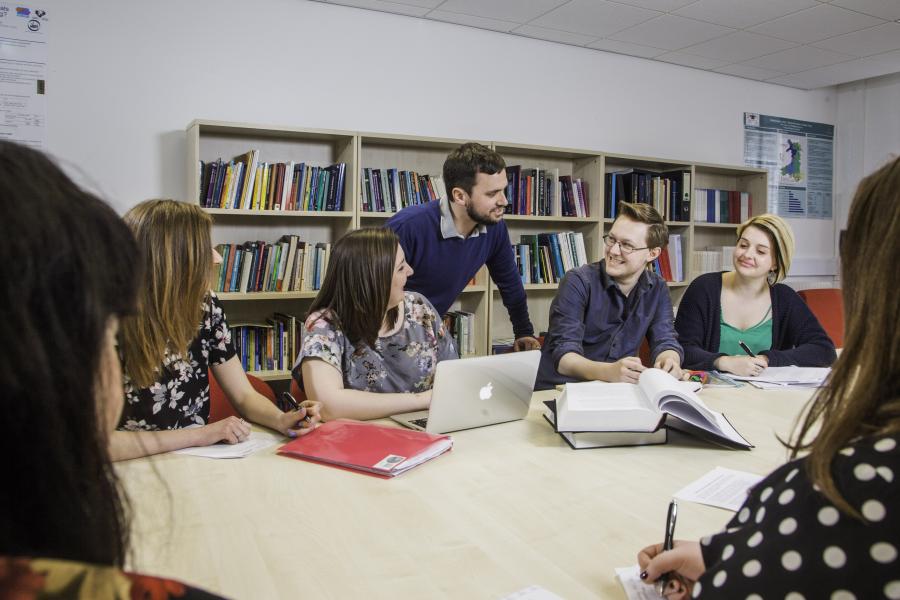
EXPLORE MORE IN LINGUISTICS
Studying linguistics will enable you to learn about, understand and interpret many aspects of human language. At Bangor you will study the ‘science’ behind language, including sounds (phonetics, phonology), words (morphology), sentences (syntax), and meaning (semantics).
Additional Course Options
This course is available with a Placement Year option where you will study for 1 additional year. The Placement Year is undertaken at the end of the second year and students are away for the whole of the academic year.
The Placement Year provides you with a fantastic opportunity to broaden your horizons and develop valuable skills and contacts through working with a self-sourced organisation relevant to your degree subject. The minimum period in placement (at one or more locations) is seven calendar months; more usually you would spend 10-12 months with a placement provider. You would normally start sometime in the period June to September of your second year and finish between June and September the following year. Placements can be UK-based or overseas and you will work with staff to plan and finalise the placement arrangements.
You will be expected to find and arrange a suitable placement to complement your degree and will be fully supported throughout by a dedicated member of staff at your academic School and the University’s Skills and Employability Services.
You will have the opportunity to fully consider this option when you have started your course at Bangor and can make an application for a transfer onto this pathway at the appropriate time. If you have any questions in the meantime, please get in touch.


My name is Kavisha Prince Anthony, and I always had a dream of studying abroad. Thankfully, that dream came to life since I applied to the Study Advisor. I was able to receive my visa within four days. I also had some visa refusals in the past; I had about six UK visa refusals in the past, but thankfully, it was not an issue since the Study Advisor was able to make things work this time. I highly recommend Study Advisor for your dreams of going abroad, whether it be the UK or any other European country there is.