
About This Course
On this course you will learn about, understand and interpret many aspects of human language. Combining these two, complementary, subjects enables you to explore of the way in which language abilities develop, while also acquiring knowledge and capabilities in the use of English language. You will examine key issues such as how our language changes according to the context in which it is being used, and how men's and women's language use differs.
Linguistics is the study of how language works and is used. Linguists look at not only how people learn, understand and speak language, but also at the way different people use language differently. Linguistics has a theoretical dimension but also an applied dimension – such as language technology, language policy and language in education. You will learn about the ways in which different languages are different or similar, the ways in which society and language go hand-in-hand, and the functions and status that different languages have across the world.
The English Language is the most widely-spoken language in the world. Studying English Language means looking at the way English has changed over the centuries, considering what will become of it in the future, comparing English use in different parts of the globe, and considering important practical aspects of English such as the hundreds of millions of people worldwide learning English as an additional or foreign language.
Why choose Bangor University for this course?
- Linguistics: Top 10 for Student Satisfaction (Complete University Guide 2019, 2020 & 2021).
- Teaching staff are key researchers - many have international reputations in the field.
- You will gain a sound and scientific insight into the structure and use of language, its history and the relationship between language and society.
- Our facilities include an extensive collection of books on Linguistics and English Language, recording and experimental equipment, and a language laboratory.
Course Content
This course will be taught by a combination of lectures, tutorials and/or seminars, depending on the module and level. You will choose 120 credits of modules relating to Linguistics and/or the English Language each year, where you start by learning the foundational knowledge required to study in this field in the different subdisciplines (year 1), proceeding to more in-depth intermediate-level study (year 2), before choosing what areas to specialize in (year 3). Modules are assessed on the basis of different kinds of coursework, including essays, reports, oral presentations, tests, exams, data analysis, etc. You will do a dissertation in your final year which represents an original research project which you will undertake under the supervision of a research-active member of staff.
Facilities
General University Facilities
Library and Archive Services
Our four libraries provide a range of attractive study environments including collaborative work areas, meeting rooms and silent study spaces.
We have an extensive collection of books and journals and many of the journals are available online in full-text format.
We house one of the largest university-based archives not only in Wales, but also the UK. Allied to the Archives is the Special Collections of rare printed books.
Learning Resources
There is a range of learning resources available, supported by experienced staff, to help you in your studies.
The University’s IT Services provides computing, media and reprographics facilities and services including:
- Over 1,150 computers for students, with some PC rooms open 24 hours a day
- Blackboard, a commercial Virtual Learning Environment, that makes learning materials available on-line.
Careers
Most walks of life benefit from having language experts on their team. As a graduate of this course you will have the knowledge and understanding needed to go into fields like the media, translation, interpreting, publishing, teaching, civil service, speech therapy, community work (e.g. related to language policy and engagement), etc. In some cases you will need further training and qualifications beyond what this course provides. A career in research is also an option, as is postgraduate study.
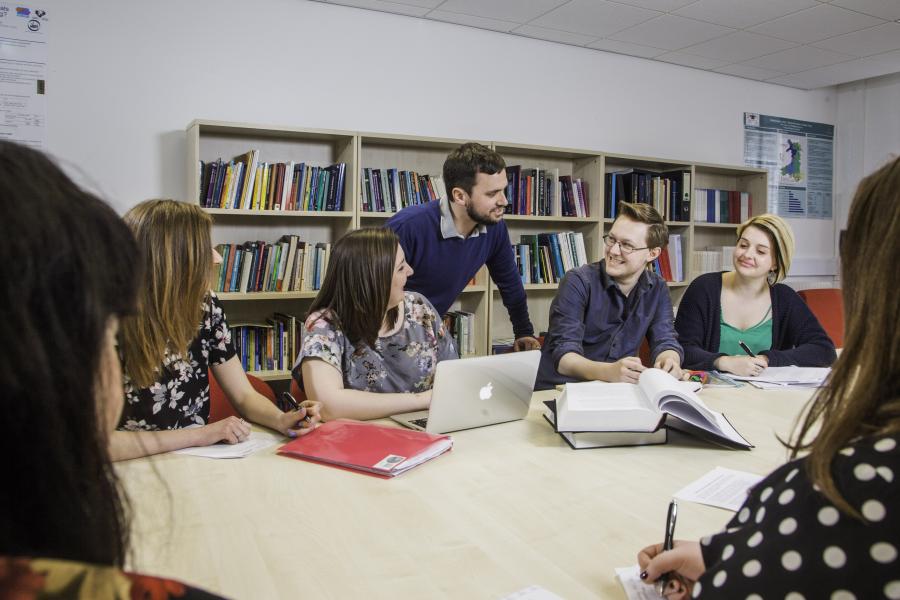
EXPLORE MORE IN LINGUISTICS
Studying linguistics will enable you to learn about, understand and interpret many aspects of human language. At Bangor you will study the ‘science’ behind language, including sounds (phonetics, phonology), words (morphology), sentences (syntax), and meaning (semantics).
International Experience Year
This course is available with an International Experience Year option where you will study for 1 additional year.
Studying abroad is a great opportunity to study with specialists, see a different way of life and broaden your horizons. With international experience of this kind, you’ll really improve your career prospects. If you plan to study in a country where English is not spoken natively, there may be additional language support available for you.
There are a wide variety of destinations to choose from and when you graduate you will have ‘with International Experience’ added to your degree title.
You can find out more about the International Experience Year programme on the Student Exchanges section of our website.
You will have the opportunity to fully consider this option when you have started your course at Bangor and can make an application for a transfer onto this pathway at the appropriate time. If you have any questions in the meantime, please get in touch.


My name is Kavisha Prince Anthony, and I always had a dream of studying abroad. Thankfully, that dream came to life since I applied to the Study Advisor. I was able to receive my visa within four days. I also had some visa refusals in the past; I had about six UK visa refusals in the past, but thankfully, it was not an issue since the Study Advisor was able to make things work this time. I highly recommend Study Advisor for your dreams of going abroad, whether it be the UK or any other European country there is.