
About This Course
This degree focuses on the study of the physics of the ocean and the processes which link it to the atmosphere and the cryosphere. You’ll focus on the roles of the shallow seas, which surround the continents, and on interactions between ice and the oceans. Field work and practical sessions are a key element of this degree. This course places a particular emphasis on gaining skills and knowledge that will be directly relevant to industry in relation to issues such as future climate change, sea level rise, marine pollution and exploitation of marine energy. The fourth year of this degree features taught modules as well as a scientific research project.
We have been teaching Physical Oceanography for over 50 years and are world leading experts in the oceanography of the shelf seas which surround the continents, and also the polar oceans.
On this course we focus on the physics of the ocean and understanding the forces which shape the global climate by moving heat around planet Earth at the present time, and also in the past. You will also study the role of the ocean in regulating global climate and in generating weather.
Physical Oceanographers are in great demand and are required to tackle issues such as predicting climate and sea-level change, marine pollution dispersion, offshore engineering related and exploitation of marine renewable energy. The quantitative and computer modelling skills gained on this course will are also in great demand across wide sectors of industry.
Why choose Bangor University for this course?
- Local fieldwork takes place in the UNESCO designated GeoMôn geopark and the Snowdonia National Park and the Menai Strait and the Irish Sea.
- Facilities: research ship, supercomputers and state-of-the art survey equipment. Oceanographic moorings for data collection.
- We have strong links globally. These include the National Oceanography Centre, the Met Office, and the offshore, hydrocarbon and marine renewables industries.
- Our graduates work in marine renewables, climate change research, offshore survey, coastal zone management and broadcast media.
Course Content
This course involves up to 25-35 hours per week of lectures, practicals in the laboratory and the field, private study, tutorials and project work. You will also complete literature reviews, exercises, essays, practical and field-work write-ups and undertake academic reading. In the third year you work on a dissertation which will provide the foundations for your fourth-year research project.
Your research project will be individually supervised by a Physical Oceanography staff member with the expertise relevant to your project. The project may take the form of field and laboratory-based experiments or the development and application of numerical models for making practical predictions of, for example, ocean temperature or the potential of tidal energy schemes. These projects are often published as scientific papers in international journals.
In your third and final years, you will be invited to a series of guest lectures (and often interviews) with prospective employees; and be offered trips to various national industry meetings (e.g., Oceanology, Ocean Business).
Our assessment methods vary - most modules combine elements of continuous assessment and formal exam.
Facilities
General University Facilities
Library and Archive Services
Our four libraries provide a range of attractive study environments including collaborative work areas, meeting rooms and silent study spaces.
We have an extensive collection of books and journals and many of the journals are available online in full-text format.
We house one of the largest university-based archives not only in Wales, but also the UK. Allied to the Archives is the Special Collections of rare printed books.
Learning Resources
There is a range of learning resources available, supported by experienced staff, to help you in your studies.
The University’s IT Services provides computing, media and reprographics facilities and services including:
- Over 1,150 computers for students, with some PC rooms open 24 hours a day
- Blackboard, a commercial Virtual Learning Environment, that makes learning materials available on-line.
Careers
Our graduates go on to be leaders in both the offshore industry and academia. This course provides an ideal preparation for careers in climate change research, marine renewable exploitation, and the offshore industry, environmental impact assessment, the water supply industry, coastal zone management as well as government advisory bodies and the scientific media.
As a graduate of Bangor University you will be a numerate, literate, team-player, someone who is able to think critically and analytically, and you will gain excellent communication skills.
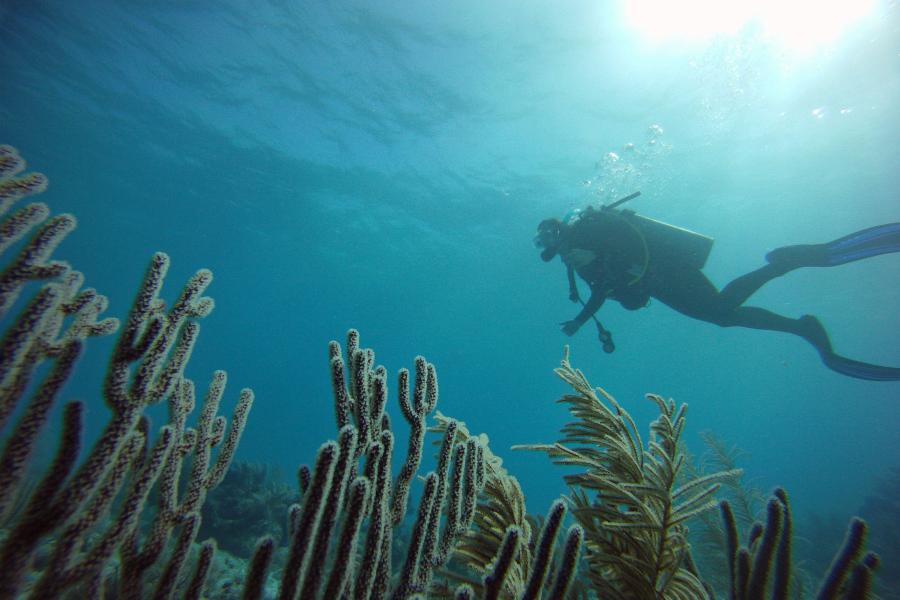
EXPLORE MORE IN OCEAN SCIENCES
Ocean Science at Bangor is unique in encompassing the study of all aspects of the global marine environment, from estuaries and coasts to the deep ocean. We are one of the largest university centres teaching marine sciences in Britain and one of the biggest in Europe.
International Experience Year
This course is available with an International Experience Year option where you will study for 1 additional year.
Studying abroad is a great opportunity to study with specialists, see a different way of life and broaden your horizons. With international experience of this kind, you’ll really improve your career prospects. If you plan to study in a country where English is not spoken natively, there may be additional language support available for you.
There are a wide variety of destinations to choose from and when you graduate you will have ‘with International Experience’ added to your degree title.
You can find out more about the International Experience Year programme on the Student Exchanges section of our website.
You will have the opportunity to fully consider this option when you have started your course at Bangor and can make an application for a transfer onto this pathway at the appropriate time. If you have any questions in the meantime, please get in touch.


My name is Kavisha Prince Anthony, and I always had a dream of studying abroad. Thankfully, that dream came to life since I applied to the Study Advisor. I was able to receive my visa within four days. I also had some visa refusals in the past; I had about six UK visa refusals in the past, but thankfully, it was not an issue since the Study Advisor was able to make things work this time. I highly recommend Study Advisor for your dreams of going abroad, whether it be the UK or any other European country there is.