
About This Course
Clinical psychology involves applying psychological understanding to difficulties connected with mental or physical health problems. Using this understanding, clinical psychologists assess and treat people of all ages and ability levels who are experiencing psychological distress, behavioural problems or related issues. Students taking the MSc in Clinical and Health Psychology will be introduced to the theory and knowledge that underpins effective practice in clinical psychology, will explore this in relation to a range of conditions, will gain an understanding of the range of research methods used by clinical psychologists, and will conduct their own research project in a relevant area.
Students wishing to can exit the programme after achieving either a PG Certificate or PG Diploma if they don’t wish to undertake the full MSc.
How the course can further your career progression
This course will be of particular interest to:
- graduates in psychology who are aiming for a career in clinical psychology and who do not yet have relevant work experience. Completing the MSc provides a sound basis for obtaining employment as an assistant psychologist and later gaining entry to clinical training.
- graduates in psychology who are aiming for a career in clinical psychology and who have already gained relevant work experience. Completing the MSc course provides evidence of academic and research skills, which is valuable when making applications for clinical training.
- graduates in psychology or closely related disciplines who are keen to pursue research in the area of clinical psychology. The MSc course is accredited as providing an appropriate research training for those wishing to progress to a PhD or to employment in a research post.
- qualified health professionals with an appropriate academic background who wish to extend their understanding of clinical psychology.
Clinical psychology training in the UK involves the completion of a three-year training programme leading to a doctorate in clinical psychology and eligibility to apply for chartered clinical psychologist status. The training is funded by the National Health Service (NHS) and almost all trainees go on to work in the NHS after qualifying. Entry to these programmes is highly competitive and applicants must have good academic and research skills as well as relevant work experience, usually two years in a paid, full-time assistant psychologist position or equivalent. The MSc Clinical and Health Psychology aims to provide students with a profile of academic knowledge and research skills which, combined with relevant work experience, will equip them to make a credible application for clinical psychology training, either in the UK or elsewhere. The School of Psychology offers both the MSc Clinical and Health Psychology and the MSc Foundations of Clinical Neuropsychology; both these courses are equally relevant as a precursor to clinical psychology training.
Course Content
What will you study on this course?
The course includes three components: content modules, research methods modules, and a research thesis. Content and methods modules are all 20 credit modules and the research thesis is worth 60 credits. Students achieving 120 credits on the taught modules, but not completing a research thesis, may exit with a Postgraduate Diploma.
The content modules are designed to provide an in-depth look at theory, evidence and practice in clinical psychology.
The course lasts one full calendar year if taken full-time and is also available part-time. During Semester 1 and Semester 2 you will combine taught modules with work on your research project. During the summer period all your time is devoted to completing and writing up the research project.
A variety of teaching approaches are used including lectures, case presentations, small-group sessions and seminars, and individual or group supervision. Assessment will include coursework and examinations, and the research thesis.
About the School of Psychology
The School of Psychology at Bangor brings together a large group of outstanding scientists with international research reputations in clinical psychology, neuropsychology and clinical and cognitive neuroscience. A number of staff also hold appointments as consultant psychologists or medical consultants with the NHS and contribute to clinical practice as well as to the training of clinical psychologists, medical students and NHS staff. The School runs its own clinical psychology training programme, leading to the Doctorate in Clinical Psychology.
Key research strengths within the clinical psychology domain include dementia, neuropsychology and rehabilitation, learning disability, developmental disorders, addictions, and cognitive-behavioural approaches. Close links with other departments and with NHS services produce tremendous opportunities for collaborative clinical psychology research. The School supports the practical implementation of research findings to improve patient care with close links to groups such as the Dementia Services Development Centre Wales.
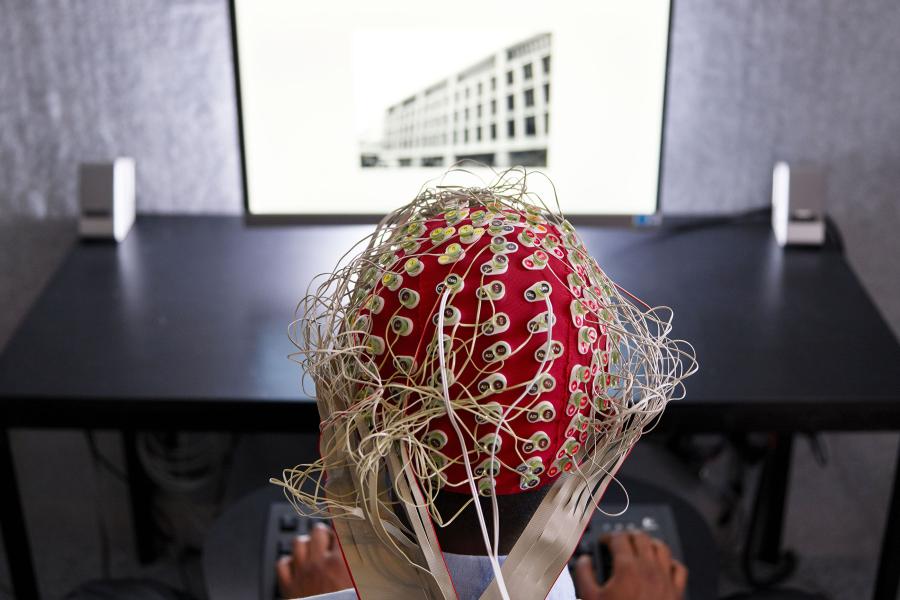
The School has an extensive library of psychological tests and measures. Participant recruitment is facilitated through the availability of research panels for neurological patients and people with dementia, as well as student and community participation panels, supported by a full-time patient co-ordinator. The School has a range of specialist laboratories and researchers and uses a wide range of the latest techniques for understanding brain-behaviour relationships, including functional brain mapping with event related potentials (ERP), transcranial magnetic stimulation (TMS), and functional magnetic resonance imaging (fMRI).
We have a vibrant, diverse postgraduate community with students on our MSc programmes drawn from a range of backgrounds and nationalities. We’re known for our friendly and informal atmosphere, which combined with excellent facilities helps to ensure that studying here is a pleasant and enjoyable experience.
Careers
This course will be of particular interest to psychology graduates aiming for a career in clinical psychology and who do not yet have relevant work experience. Completing the MSc provides a sound basis for obtaining employment as an assistant psychologist and later gaining entry to clinical training. For graduates who already have relevant work experience the course provides evidence of academic and research skills, which is valuable when making applications for clinical training. It is also an excellent preparation for graduates who are keen to pursue research in the area of clinical psychology and for qualified health professionals with an appropriate academic background who wish to extend their understanding of clinical psychology.
Research / Links with Industry
The academics involved with this programme have extensive research links with external bodies and companies, which are fully utilised in ensuring that the modules are relevant to the modern work and research environment graduates will enter
EXPLORE MORE IN PSYCHOLOGY
Psychology as a science and as a profession makes a difference to real people in the real world, by improving quality of life across a wide range of areas. We are proud of our strengths in both the teaching and learning and research domains, ensuring that you’ll be learning the science and application of psychology from world class researchers and lecturers.


My name is Kavisha Prince Anthony, and I always had a dream of studying abroad. Thankfully, that dream came to life since I applied to the Study Advisor. I was able to receive my visa within four days. I also had some visa refusals in the past; I had about six UK visa refusals in the past, but thankfully, it was not an issue since the Study Advisor was able to make things work this time. I highly recommend Study Advisor for your dreams of going abroad, whether it be the UK or any other European country there is.