
Overview
Businesses, society and policy makers are recognising that change is required at all levels if we are to address the challenge of sustainable energy and development and meet the needs of future generations. At DMU, our Energy and Sustainable Development MSc reflects the knowledge and skills required by professionals working to tackle climate change.
On this course, you will develop an understanding of how sustainable development can be achieved and how we can deal with global climate change through sustainable energy, more efficient design and manufacturing, better management of buildings and organisational behaviour change. You will learn from leading academics and specialists from the Institute of Energy and Sustainable Development (IESD), as well as a range of invited experts and guest speakers.
You will graduate with the skills and knowledge to lead communities, organisations and governments. This course is ideal for individuals with a social science or physical science background, or for mid-career professionals with relevant experience.
Key features
- Our IESD research and teaching staff provide you with the opportunity to learn from scientists actively involved in furthering knowledge and sharing  expertise.
- The course is accredited by both the Chartered Institute of Building Services Engineers (CIBSE), an international body which represents and provides services to the building services profession, and the Energy Institute, the leading professional body for the energy industries. This assures you that the course content is industry-relevant.
- The course is designed to be flexible and fit around your commitments with on campus, part-time or full-time or distance learning options available.
- Graduate equipped with the relevant knowledge and expertise required for careers in the industry, with course content relevant to modern day practice, including relevant research projects and industry-related issues.
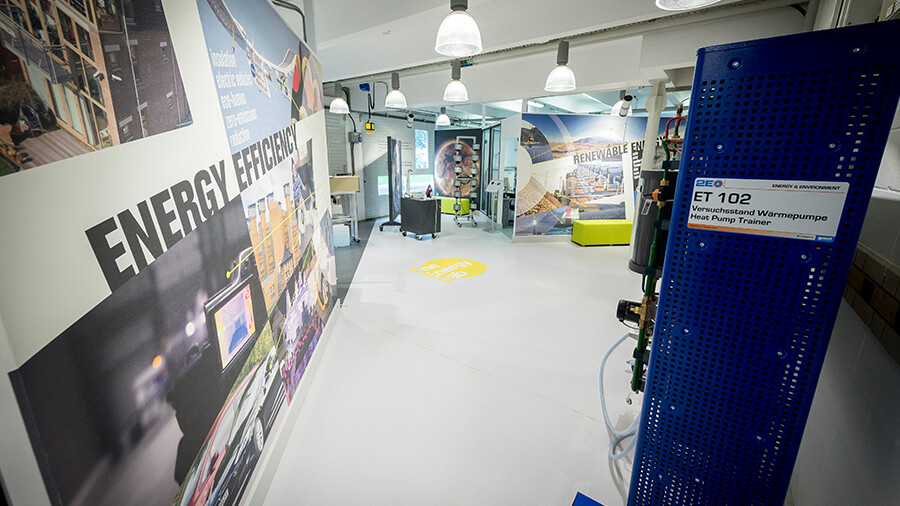
- Access specialist facilities such as the Energy Laboratory, a high-tech hub for teaching, research and technology demonstration.
- Study a course with excellent graduate prospects. Graduates have gone on to work for global companies including the Carbon Trust, BMW, National Grid and the European Commission, as well as a variety of other energy and environmental consultancies, central and local government and multinational organisations.
"I had been working as a sustainable energy consultant for over a year when I decided to study for an MSc at IESD. The course is structured so that it is possible to study part-time over 2 years and attending the University one day a week, which worked really well for me. There is also the option of distance learning."
Sarah Blois-Brooke, graduate
Structure and assessment
Sustainable Development covers the key concepts of sustainable development and sustainability. This module discusses social, ecological and economic sustainability concepts and encourages you to develop a critical appreciation of the sustainable development debate
Sustainable Energy describes the sources of energy, and how they are exploited with a wide range of technologies, with an emphasis on their environmental impacts and long-term sustainability
Sustainable Buildings introduces you to the main aspects of sustainability in regards to the built environment, exploring the environmental, economic and social/cultural issues that need to be considered for achieving successful building design and operation. Topics covered include climate-responsive design, low/ zero carbon performance, energy and water consumption, human factors and urban planning
Resource-Efficient Design provides a grounded understanding of resource-efficient design in both industrial and non-industrial contexts.
This module will adopt a 'whole systems' perspective to the introduction of students to the design process and will encourage them to analyse each stage of development in terms of its impact on resource use and overall energy consumption
Energy Analysis Techniques is a particularly practical module that will equip you with the skills to analyse energy data from buildings and industrial processes, and to carry out energy audits and surveys to identify energy and greenhouse gas saving opportunities.
Issues such as heating, lighting, ventilation and general energy use are considered, and crucially, ways to bring about energy savings and how to make energy saving recommendations, sometimes as much as 20% with zero (or very low) investment.
The case studies we use are mainly for non domestic buildings but all of the techniques can also be applied to dwellings.
The module includes the theory behind energy analysis, and we carry out practical building surveys, and data analysis in lab sessions, the assessment being to prepare a report similar to one you would produce as a professional energy efficiency consultant.
Study Skills and Research Methods provides the skills necessary to successfully complete a research project of a high standard, introducing you to a range of research methodologies and practices relevant to the successful completion of the MSc
Dissertation will complete the MSc by undertaking a research project on a topic of your choice, supervised by an experienced member of research staff
Optional Modules:
Leading Change for Sustainability aims to equip students with theoretical knowledge and practical skills to enable them to play an effective leadership role in promoting sustainability. The module draws upon applied environmental psychology and theories of social and organisational change as its theoretical basis, alongside practitioner-developed understandings of behaviour change and social transformation. The knowledge and skills developed are intended to be applicable in a range of settings, including organisations, government, communities and the personal sphere.
Low-Impact Manufacturing introduces the concept of an industrial system, linking different types of industry, including raw material processing, manufacturing and waste processing, that combine to satisfy consumer demand. It explains the ways in which energy and resource use can be identified at each stage of a product life-cycle and how the associated environmental impacts can be identified and mitigated.
Key international standards relevant to sustainable manufacturing are described, and a technical approach is taken throughout the module
Engineering Business Environment enables you to understand and reflect upon the role of businesses in a rapidly changing, globalised world. As well as considering the changing environment in which businesses operate, time is spent exploring the steps a business can take to respond to the environmental challenges ahead; for example, through supply chain management, logistics, life-cycle analysis, green accounting and carbon trading
You will complete the MSc by undertaking a research project on a topic of your choice, supervised by an experienced member of research staff.
Note: All modules are indicative and based on the current academic session. Course information is correct at the time of publication and is subject to review. Exact modules may, therefore, vary for your intake in order to keep content current. If there are changes to your course we will, where reasonable, take steps to inform you as appropriate.

Facilities and features
Internships, Careers and Placement
DMU Dubai careers department aims to assist the University students and
graduates to make informed career choices by providing a professional, high quality
careers guidance and information service for students and recent academic
schools to support students by developing the skills they need to maximize their
employability. This includes a number of sector specific careers fairs and insight
events, organized at DMU Dubai Campus throughout the academic year. The aim of
these events is to make students aware of the work experience, internship and
permanent positions available. We also encourage earlier years to attend such
events as a useful way to develop their understanding of industry.


