
Do you ever wonder how our universe came to be? Our Astrophysics Foundation Entry degree course will help you find the answers and lead to a rewarding career in this field.
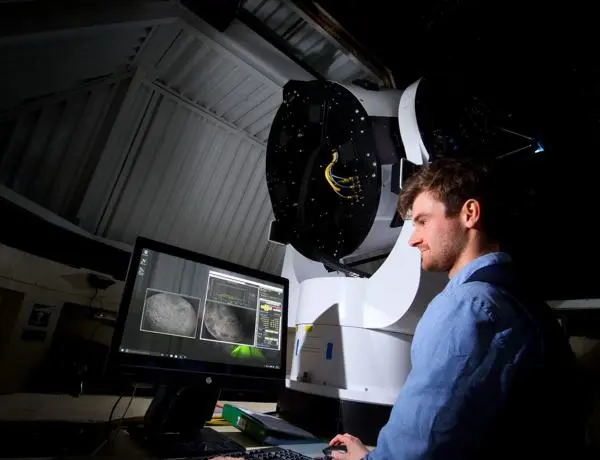
You’ll gain an understanding of how to apply physics to the stars and galaxies which make up our universe, whilst developing skills in scientific methods.
Through our well-resourced observatory and laboratory facilities, you’ll develop a sophisticated practical and theoretical knowledge base during your BSc (Hons) Astrophysics course.
Foundation Entry degree courses are ideal if you’ve got the ability to study for a degree, but don’t have the necessary formal qualifications to directly join an honours programme. It’s a great stepping stone to a full degree.
Why study with us
- You’ll also develop your mathematical skills, and benefit from a state-of-the art learning environment for practical analysis, interpretation and modelling of astronomical data.
- You’ll gain excellent observational, mathematical and logical skills as well as problem-solving abilities.
- Physics and Astronomy is ranked 2nd in the North West for research intensity (CUG, 2022). Research intensity is a measure of the amount of staff involved in high-quality research in the university.
What you'll do
- In the 2022 National Student Survey, 92% of Physics and Astrophysics respondents were overall satisfied with their course, with a 90% rating for the teaching on the course.
- The University has its own observatory, the Alston Observatory, one of the largest teaching observatories in the UK, which you’ll get to use during your BSc (Hons) Astrophysics course.
- You’ll also benefit from an excellent learning environment, with state-of-the-art facilities used for practical analysis, interpretation, modelling astronomical data and specialised research software.
Module overview
Year OCompulsory modules
• APC801: Foundations of Applied Physics
• APC802: Motion, Forces and Force Fields
• APC803: The Road to Quantum Mechanics
• MAC811: Pure Mathematics and Statistics
• MAC833: Mathematical Methods
Year 1
Compulsory modules
• AA1003: Astrophysics 1 - The Structure of the Universe
• AP1043: Electromagnetic Radiation and Quantum Theory
• AP1842: Mechanics
• AP1852: Applied Physics and Linear Systems
• AP1860: Practical Physics 1- Programming and Experimental Physics
• MA1831: Functions, Vectors and Calculus
Year 2
Compulsory modules
• AA2001: Astrophysics 2
• AP2043: Electromagnetism and Waves
• AP2858: Thermal and Quantum Physics
• AP2859: Special Relativity and Solid State Physics
• AP2860: Practical Physics2 - Computing and Experimental Physics
• MA2831: Ordinary Differential Equations
Year 3
Compulsory modules
• AA3010: Formation, Structure and Evolution of Stars
• AA3853: Cosmology and Galaxies
• AP3860: Practical Physics 3- Experimental Physics and Problem Solving
• AP3950: Physics/Astronomy Project
Optional modules
• AP3842: Nuclear and Particle Physics
• AP3844: Atomic Physics and Advanced Quantum Mechanics
• AP3845: Electrodynamics, Plasma and Solar Physics
• MA3831: Partial Differential Equations and Integral Transforms
Course delivery
This course is taught face-to-face at one of our UK campuses.
Every effort has been made to ensure the accuracy of our published course information. However, our programmes are subject to ongoing review and development. Changing circumstances may cause alteration to, or the cancellation of, courses. Changes may be necessary to comply with the requirements of accrediting bodies or revisions to subject benchmarks statements. As well as to keep courses updated and contemporary, or as a result of student feedback. We reserve the right to make variations if we consider such action to be necessary or in the best interests of students.
Future careers
Graduates of our BSc (Hons) Astrophysics degree are amongst the most employable around because of their analytical and mathematical skills. Your skills make you particularly attractive to employers, not just in astrophysics, but in a wide range of fields including oil and gas, and medical physics.
Our graduates find jobs in industry, government research institutes, overseas laboratories and observatories, financial institutions, teaching and scientific journalism.


My name is Kavisha Prince Anthony, and I always had a dream of studying abroad. Thankfully, that dream came to life since I applied to the Study Advisor. I was able to receive my visa within four days. I also had some visa refusals in the past; I had about six UK visa refusals in the past, but thankfully, it was not an issue since the Study Advisor was able to make things work this time. I highly recommend Study Advisor for your dreams of going abroad, whether it be the UK or any other European country there is.